
Rubric Grading: Why It Beats Grading Essays Without One
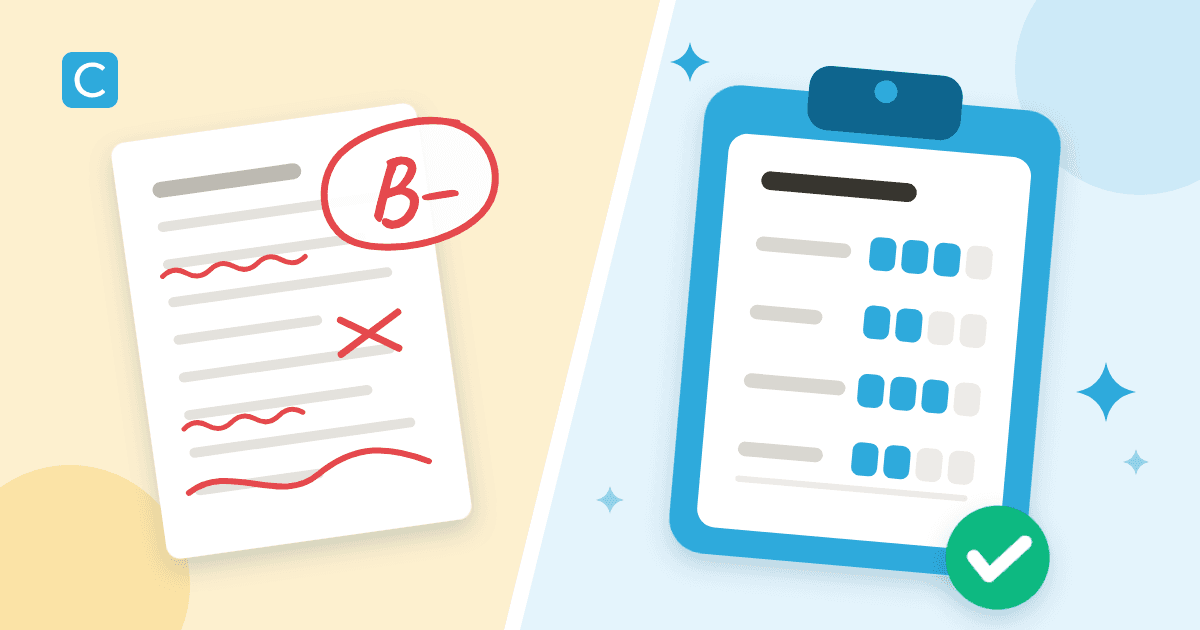
When you start grading essays, you're probably fresh. By essay 28 of 30, it's late and you're tired. Would you grade essay 1 and essay 28 the same way?
Rubric grading means scoring every essay against the same written criteria and performance levels. Compared with grading without a rubric, it gives more consistent grades and clearer feedback, as long as the rubric is clear and you apply it the same way every time.
Below, we look at what the research says about rubric-based grading, grade one essay both ways, and cover where rubrics fall short and how to start.
What Is a Rubric Grading System?
A rubric grading system is a set of written criteria that tells you what to look for in an essay and how many points each level earns. Instead of one overall impression, you score separate parts of the writing, such as the thesis, evidence, organization and conventions, against descriptions you wrote before grading started.
So what is a grading rubric? It's the document that holds those rules. A typical essay scoring rubric has four parts:
- Criteria: the skills you're judging, such as argument, evidence, organization and grammar.
- Performance levels: the scale, from excellent to needs work.
- Descriptors: what the work looks like at each level.
- Points: what each level is worth, for example 4 for excellent and 1 for needs work.
Here's a simple four-level rubric for an argument essay:
| Criteria | 4 - Excellent | 3 - Good | 2 - Developing | 1 - Needs work |
|---|---|---|---|---|
| Thesis | Clear, strong argument | Clear argument | Needs focus | No clear argument |
| Evidence | Strong facts and examples | Useful details | Few details | Little evidence |
| Organization | Ideas flow clearly | Mostly organized | Some ideas misplaced | Hard to follow |
| Conventions | Very few errors | Some small errors | Several errors | Errors affect reading |
This is an analytic rubric: it scores each criterion separately. A holistic rubric gives the whole essay one score instead. Analytic rubrics give more detailed feedback; holistic ones are faster. For full examples by essay type, see our essay rubric examples.
Rubric Grading vs. Grading Without a Rubric
With a rubric, every essay is graded against the same written criteria, so the grade depends on the writing. Without one, the criteria live in your head. They can shift with the time of night, the order of the stack, or the essay you read just before. Here's where that difference shows up:
| Grading with a rubric | Grading without a rubric | |
|---|---|---|
| What the grade is based on | Written criteria and performance levels | The teacher's overall impression |
| Essay 1 vs. essay 30 | The same criteria for every essay | Standards can drift with tiredness or order |
| Two teachers, one essay | Both score against the same criteria | Scores can differ with each teacher's priorities |
| Feedback | Points to the skill that needs work | Often general ("good ideas, add detail") |
| Explaining a grade to a student or parent | Point to the exact criterion and level | Defend a personal judgment |
| Risk of bias | Narrows attention to the criteria | First impressions can sway the grade |
| What students know before writing | The target, criterion by criterion | They have to guess |
| Writing comments | Level descriptions do much of the explaining | Each comment written from scratch |
Without a rubric, your criteria for grading essays still exist. They just live in your head, and they shift. You might grade one essay mostly on grammar and the next mostly on its argument. Writing the criteria down before you start gives you and your students the same target for every essay.
Rubric Grading Examples: Grading One Essay in Two Different Ways
The best way to understand the difference between rubric grading and not using a rubric is with an example. Imagine that you asked students to write about why schools should offer more outdoor activities. A student hands in the following essay:
Why Schools Need Outdoor Activities
Schools should offer students more outdoor activities. This will allow them to spend more time playing and learning outdoors. Outdoor activitys will help students stay active and spend less time indoors. For example, playing a game of soccer or taking a walk in nature can help students learn to work in teams and better understand the world around them.
Some students may not find it easy to learn outside, they prefer quiet places to learn. However, teachers can plan for this by planning different activities for different groups. Schools can also use outdoor activities to teach students about science, plants, and the environment. This way, students will learn in a more interesting way.
We think schools should offer outdoor activities each week. They are a good way to stay healthy and learn new things.
Grading Without a Rubric
You think that this student has made some good points. The ideas are good, though the argument could be stronger. It also has few examples. Your feedback might look like this:
- Grade: B-
- Comment: You have good ideas. Be careful with your grammar and try to include more details.
The student now knows their grade, but not whether they should improve their argument, add more examples, or organize their ideas.
Grading With a Rubric
In this case, you grade the student on 4 criteria, each scored out of 4. This is a simple example of a rubric for grading that gives the student more detail than a single overall grade.
| Criterion | Score | Reason |
|---|---|---|
| Thesis | 3/4 | Clear main point, but argument could be stronger |
| Evidence | 2/4 | Has some examples, but needs more facts and details |
| Organization | 3/4 | Ideas organized in a clear manner |
| Conventions | 2/4 | Some problems with writing and sentence choices |
| Total | 10/16 |
The student can see that their organization was good, but they need to strengthen their evidence. The teacher can also explain this grade to them based on the rubric criteria.
Why Grading Rubrics Make Essay Scores More Consistent
Grading rubrics, or rubrics for grading, help teachers keep the same criteria in mind for every essay. Rather than relying on feelings or fatigue, a teacher can focus on what they are actually grading. Rubrics can also increase interrater reliability, i.e., consistency in grading, according to research.
When you are grading 30 essays, it is normal to take a closer look at the first few essays. After you have read several, you might rush through the rest because you are tired. It is also natural that after reading a bunch of poor essays, a good essay may stand out more. After reading several excellent essays, a good essay may seem less impressive. This is not a sign that the teacher does not care; it is a problem humans face!
The grading rubric provides you with a guide and a reminder of the criteria you need to grade on for essay 1 and essay 30. According to Jonsson and Svingby's (2007) review of 75 studies, rubrics can improve reliability, especially when they are analytic and task-specific and when sample essays and rater training are also used. However, a rubric does not ensure that your judgment will be valid.
A shared guide can help teachers grade essays consistently and explain why one piece of work received a higher score than another.
Are Teachers Biased When Grading? What a Rubric Can and Cannot Do to Help
While you do your best to grade fairly, there will always be some bias in your judgment. A rubric helps you focus on the assignment and the given criteria; however, it cannot remove subjectivity entirely. To reduce it further, you can take other steps like clarifying the rules, sample grading, and even blind grading. This matters because teacher bias in grading can affect how students are assessed, even when teachers are not aware of it.
Some teachers are also biased by students' previous performance or other characteristics. Malouff and Thorsteinsson (2016) found that unrelated information such as students’ background and performance could impact their grades. In the review, the overall effect of such factors was g=0.36.
The study by Malouff, Emmerton and Schutte (2013) found that when the raters watched the same student give an excellent presentation, they also graded their unrelated written assignments higher. This phenomenon is called the halo effect in grading.
A rubric can help direct the grader's focus to the essay’s criteria rather than the student’s reputation. You can also practice blind grading where student names are hidden. Yet even with a well-defined rubric, vague descriptions can still lead to bias. So, a rubric helps ensure fair grading, but it’s not a guarantee. It is one useful part of learning how to grade essays fairly.
Rubrics Help Students Write Better, Not Just Get Fairer Grades
A rubric can make your students better writers. Before they start their writing assignments, a rubric helps them understand what a good essay looks like. Then, instead of looking at their grade and wondering what went wrong, students can use the rubric to plan, check, and edit their essays.
Panadero et al. (2023) reviewed 21 studies and found that a rubric had a moderate positive effect on students’ academic performance (g=0.45). The effect on self-regulation and self-efficacy was also positive but less clear. In a review of 46 studies, Brookhart (2018) found that all 13 studies measuring learning or motivation showed positive results.
When you give your students an assignment, give them the rubric as well. This way, they can review their own assignments or even swap them with another student. In this way, they learn that good writing is not just about grammar and spelling, but also about ideas, evidence, and organization. That's one of the biggest benefits of rubrics: students can use them before the grade, not just after.
Does Using a Rubric to Grade Assignments Save Time?
A rubric can save you time because you can make decisions about the scoring and feedback while preparing. However, it won’t eliminate the need for reading every essay because you need to understand what students are writing. The main benefit of a rubric is that you do not have to explain your marking criteria again every time.
For example, without a rubric, you might end up writing a similar comment about evidence, argumentation, organization, and so on. A rubric lets you avoid that. For context, a January 2025 survey of 258 US teachers by Learnosity and Perspectus Global found they spent an average of 9.9 hours grading each week. But they didn’t assess whether rubrics save any time.
The advantages of using rubrics are not limited to time. They can also make feedback easier to follow and help teachers explain their decisions. Rubrics are useful, but they still need careful planning and review.
What Happens When Rubric Grading Fails to Deliver? How to Fix It
While a rubric can be a helpful tool, it does not solve all your problems with grading. You might find that, even with a rubric, some students are confused by the descriptions or get different scores for the same work. Here are the most common disadvantages of rubrics, and how to fix each one.
Your rubric descriptions are too vague. Criteria like ‘good’ don't help students understand what you expect. In a small study, Jeong (2015) found that teachers' scores rose when they switched to a rubric, partly because its level descriptions were lenient. The solution is to define each level clearly.
Students are getting penalized for grammar and spelling instead of ideas and argumentation. Even with a rubric, untrained graders can still be affected by spelling and grammar. Rezaei and Lovorn (2010) found evidence of this. One solution is to weight skills you consider most important more heavily and to practice with sample essays.
Students focus on earning points rather than generating their own ideas. Kohn (2006) warns that a rubric can discourage creativity and make students focus on formulaic writing. The solution is to allow some creativity and personal voice in students’ writing.
A rubric can’t guarantee fair grading. Even with the same descriptions, you might still grade students unevenly. The solution is to practice on some sample essays and align your understanding of the criteria.
So, while rubrics have many benefits, they're only as good as the clarity of the criteria and how you use them. Still, Panadero and Jonsson (2020) reviewed 27 critical publications and found that most arguments against rubrics were based on weak or indirect evidence. Treat the problems above as design warnings, not reasons to drop rubrics.
How to Use a Rubric for Grading Essays
To use a rubric for your essay grading, you do not need a detailed one. As long as the criteria are clear, a short rubric can help you. Follow the steps below to learn how to use rubrics for grading or how to use a grading rubric.
- Start by thinking about the assignment you want your students to do. What do you want them to learn from it? Define three to five criteria for the rubric that reflect your lesson goals. Our guide on how to make a rubric walks through each step.
- Then, think about how to describe each level clearly. For example, what is a strong thesis statement? You can say it is one that presents an argument and answers the question.
- Next, make sure that each criterion has an appropriate weight. For example, you might want ideas and evidence to count more than spelling. Before grading, decide on the points for each level. In the end, your criteria for grading an essay should reflect the purpose of the essay. If you need help building a rubric and editing it as you go, you can use Clasa's Rubric Maker.
- Before using it, test it on some sample essays. Grade two or three. Try asking another teacher to grade them and discuss any differences.
- Share the rubric with your students together with the assignment. This way, they know how their work will be graded.
- When grading, focus on one criterion at a time. For instance, read all the essays’ theses before looking at the supporting evidence. Try to obscure students’ names as much as possible.
- Try to offer a helpful comment with the grade. Explain what the student did well and what needs improvement. For example: “Your argument is clear, but you should add facts to support it.”
- See how the class did overall. If many students had difficulty supporting their arguments, plan a new lesson to help them.
Rubric Grading With AI: The Same Rubric for Every Essay
AI essay grading can be a great help when a teacher needs to grade many essays. But to use an AI essay grader with rubric criteria, you need to provide the rubric. Without a rubric, an AI essay grader has to guess what you value, just like a human teacher would. They need to know what parts of an essay are more important than others.
The AI tool can grade argument, evidence, organization, grammar, and other aspects separately and connect the feedback to rubric criteria. The teacher can then review the scores and feedback, edit them, and approve the final grade.
Clasa, for example, has a large library of ready-made rubrics. We have 648 rubrics, including rubrics for AP Lang, IB, ENEM, IELTS, and TOEFL. Teachers can also upload their own rubric, use the Rubric Maker, or grade essays based on the assignment instructions. On Clasa, you can upload PDFs, Word documents, and images or scans of handwritten essays.
Clasa generates scores for each criterion in the rubric and feedback connected to the rubric criteria. The teacher can review the scores and feedback, edit them, or even regrade the essay. Feedback is provided in 27 languages, and Clasa doesn’t ask for student names. We don’t train on students’ essays, and the teacher can delete the essays at any point.
The AI should help the teacher make a decision, not replace it. Make sure you review the feedback and keep the final decision in your hands. An AI grader with rubric criteria can support the process, but the teacher remains responsible for the final grade.
Want to see it in action? Grade an essay against your rubric with Clasa.
Frequently Asked Questions
What Is a Grading Rubric?
A grading rubric is a document that describes how work will be graded. It outlines criteria and performance levels and assigns points to them. Rubrics help teachers grade work consistently and help students understand what’s expected of them.
Is Rubric Grading Fair?
It can make grading fairer because it lets teachers grade using the same criteria. However, it doesn’t eliminate bias entirely. Clear descriptions and anonymous grading can help.
Is a Holistic Rubric Also Rubric Grading?
Yes, a holistic rubric is a form of rubric grading. It assigns one score to the work, while an analytic rubric provides separate scores for aspects of the work, like argument, evidence, and grammar.
Does Rubric Grading Make the Grading Process Faster?
It can reduce the number of times you need to write the same comment. However, you still need to read all the essays. How much time you save depends on the assignment and the number of students in your class.
What Are the Disadvantages of Rubric Grading?
If the criteria are unclear, students can get confused about the expectations. Strict criteria can also limit students’ creativity. Finally, teachers may interpret the rubric descriptions differently. Clear wording and sample essays can help with this.
How Many Criteria Should an Essay Rubric Have?
For a start, three to five criteria should be enough. Only include skills that are important for the essay, such as argument, evidence, and organization.
Should Students Know the Rubric Before Writing an Essay?
Yes, this helps students understand what they’re being graded on. This lets them plan their essays and even check them before submitting them.
Can AI Grade Essays With a Rubric?
Yes, an AI essay grader can suggest a score and feedback based on the rubric criteria. However, you need to review the grade and feedback and approve them before making them final.
Conclusion
When grading essays without a rubric, your expectations are more likely to change. Writing a rubric allows teachers to have a common set of rules when grading essays, while students can better understand what they need to improve. It’s not perfect, but it can help make the grading process easier.
Try using a rubric for the next essay assignment. Make sure to test it on sample work to see how it works. If you want support with grading essays, Clasa can help. You can grade essays with your own rubric and review the scores and feedback for each essay to approve the final grade.
Try Clasa by grading an essay with your own rubric and reviewing the results.