
How to Make a Rubric: A Step-by-Step Guide
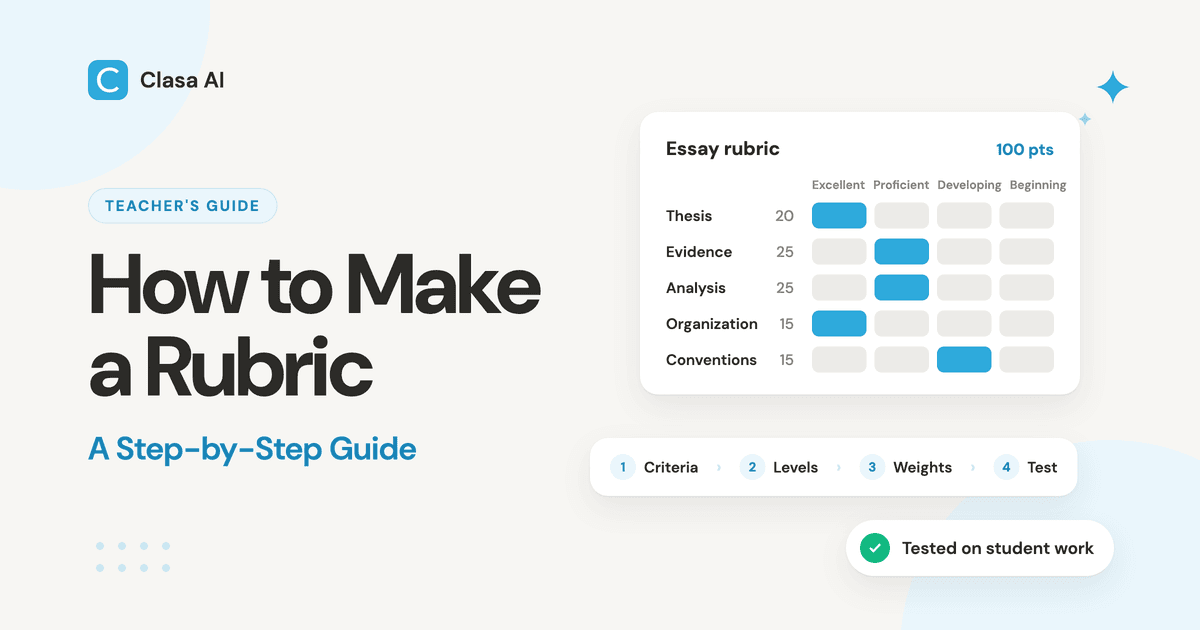
To make a rubric, start with the assignment and its learning outcomes, choose the type of rubric, select four to six criteria, set your performance levels, write a specific description for each level, weight the criteria, and test the rubric on real student work before you grade with it.
A rubric, in short, is an assessment and scoring guide that explains how a project, presentation or assignment will be judged. It will outline the criteria for what is being assessed, the performance levels and their descriptions, and the method for scoring.
For a teacher, a good rubric brings a certain system to grading. For the student, it clarifies expectations before the work is even turned in. But a well-constructed one does more than that; it provides a consistent way to evaluate work and shows students the standard for success.
There are some caveats to consider. A review of 75 studies by Jonsson and Svingby (2007) found that rubrics can enhance the reliability of scores, especially when they are analytic, topic-specific and complemented by rater training or exemplars. But they do not in themselves guarantee a valid assessment. A poorly designed rubric may produce consistent scores but still be measuring the wrong things.
How to Make a Rubric Step by Step
The assignment itself should be the starting point, rather than an empty grading table. The objective is to have the rubric reflect what the assignment is meant to measure.
1. Start with the Assignment
Read through the directions in full before you decide on your criteria. Ask yourself what makes the work successful, what skills it must demonstrate and which parts are essential. What would indicate that the learning objective has been missed?
With an essay, for instance, one would expect an argument, evidence, source analysis and proper citations. This approach keeps the rubric from becoming a generic checklist, which aligns with Cornell's guidance on using rubrics.
2. Identify the Learning Outcomes
Decide what you want the student to show you. It is best to make broad goals observable. Rather than writing "understand persuasive writing," specify that the student "develops a clear claim and supports it with relevant evidence."
Or instead of "understand how to conduct an experiment," ask for accurate recording of observations and an explanation of how the evidence relates to the hypothesis. This gives the teacher concrete evidence of the intended skill to look for when grading. These learning outcomes provide the foundation for everything that follows.
3. Choose the Type of Rubric
The format should suit the assessment being evaluated. An analytic rubric is a good choice when a student needs detailed feedback on a number of skills, as each criterion is scored separately.
A holistic rubric offers an overall judgment of the work, which can be preferable when the various components are difficult to separate. Then there is the single-point rubric, where the standard is explained, and the teacher notes where the work falls below or above it. The University of Illinois Chicago's rubric guide has more to say on the benefits of these different formats and when to use each.
A checklist, by comparison, will show you whether a requirement is complete or not, which is fine for simple matters. But when it comes to making complex quality judgments, that approach falls short. For a more detailed view of the distinction between analytic and holistic rubrics, one might look to Yale's rubric guidance.
In the end, whether one opts for an analytic, holistic or single-point approach, the goal is the same: to create a tool that is both fair and informative. Choosing the format before building the scoring criteria can make the rest of the process much easier.
4. Choose the Criteria
Focus on the major areas that connect to the learning objectives; there is no need to grade every possible attribute of the work. On an essay, you might have separate lines for the thesis, organization, analysis and citation. For a science project, the list could include the experimental procedure, data collection and other relevant areas.
Be sure the categories are distinct enough to be clearly differentiated at grading time. One should avoid too much overlap between, say, "quality of ideas" and "strength of ideas" unless the distinction is clear.
5. Set Your Performance Levels
You have to determine how many levels are needed for the assignment. Rubrics typically use three to five, and four is a common choice for classroom use, as an even number keeps graders from defaulting to the middle. You could opt for labels like:
- Excellent
- Proficient
- Developing
- Beginning
Or perhaps:
- Exceeds Expectations
- Meets Expectations
- Approaching Expectations
- Does Not Meet Expectations
Do not focus too much on the label itself; the description is what counts. It has to be clear to the student where one level ends and another begins. There is no point in using adjectives that do not provide meaningful information:
- Excellent: Very good work
- Good: Good work
- Fair: Fair work
- Poor: Poor work
Such descriptions offer no guidance for improvement.
6. Be Specific in Your Descriptions
Writing the performance descriptions is arguably the most important part of the process. A weak entry would be "Excellent analysis." A better way to put it is: "Explains how relevant evidence supports the central argument and connects individual examples to the broader interpretation." The same applies to organization. "Good organization" is too vague; instead write that the student "presents ideas in a logical sequence with appropriate transitions that support the argument." Cornell's assessment guidance is to avoid subjective criteria in favor of clear indicators.
The descriptions should tell the teacher what to look for and the student what successful work looks like.
How to Make a Rubric for Assessment Without Overcomplicating It
More rows do not necessarily mean a better assessment. A practical rubric might have four to six major criteria, each directly linked to the learning outcomes of the assignment. Adapt the descriptions to the assignment rather than relying on a generic template. Consider this example for a ninth-grade argumentative essay, scored out of 100 points:
| Criterion (points) | Excellent | Proficient | Developing | Beginning |
|---|---|---|---|---|
| Thesis (20) | States a specific, arguable claim that answers the prompt | States an arguable claim, but it is broad or loosely worded | States a fact or a topic, or only partly answers the prompt | No identifiable claim |
| Evidence (25) | Relevant, accurately cited evidence supports every main point | Most evidence is relevant and cited; one or two pieces are loosely connected | Evidence is thin or general and often not tied to the claim | Little or no relevant evidence |
| Analysis (25) | Explains how each piece of evidence supports the claim and answers a counterargument | Explains most of the evidence; a counterargument is mentioned but not answered | Mostly restates or summarizes the evidence | Summary only, with no explanation |
| Organization (15) | Each paragraph has one clear point, and transitions show how ideas connect | Ideas follow a logical order, with some weak transitions | Some paragraphs mix ideas or appear out of order | Difficult to follow |
| Conventions (15) | Few or no errors, none of which affect meaning | Some errors, none of which affect meaning | Frequent errors, a few of which affect meaning | Errors often make the meaning unclear |
Whatever the assignment, the important point is to keep every criterion connected to what it is actually intended to measure.
How to Weight Rubric Criteria
You must decide the weight of each criterion toward the final score. In the essay rubric above, for instance, the thesis is worth 20 points, evidence and analysis 25 points each, and organization and conventions 15 points each.
The weighting should match the assignment's purpose and signal to students what matters most. An analysis worth 25 points demands more attention than a formatting detail. Do not default to equal weighting just for convenience.
The Jonsson and Svingby review indicates that rubrics, especially when they are topic-specific and analytic, can lead to more reliable scoring, particularly when rater training or exemplars are available. Yet the researchers caution that a rubric is no guarantee of valid judgment.
It is therefore worth paying attention not only to the final score but also to whether the scoring criteria produce useful information about student performance.
How to Make a Rubric for Elementary Students
Keep it simple in terms of language and the number of criteria. Younger children will not get much out of lengthy academic language. For a third-grade writing piece, the criteria should be statements they can understand: "I have a beginning, middle and ending," or "I used complete sentences."
Performance levels might be written as:
- 4 — I can do this on my own, every time.
- 3 — I can do this on my own most of the time.
- 2 — I can do this with some help.
- 1 — I am just starting to learn this.
Visual aids are fine for younger learners as long as they support, rather than replace, the description. The aim is to set clear expectations without making things unnecessarily complicated.
How to Make Rubrics for an Essay
Because an essay calls on a student to use a number of different skills, its rubric deserves some extra thought.
The best place to begin is with the purpose of the essay. Where the work requires students to put forward an argument supported by textual evidence, the rubric ought to put the focus on that analysis and the quality of the evidence, not let a few grammatical slips dictate the final grade. The example above uses these five criteria:
- Thesis – is the central claim arguable and well-defined?
- Evidence – has the student chosen what is relevant and cited it correctly?
- Analysis – does the student make a case for why the evidence is important?
- Organization – are the ideas put together in a logical fashion?
- Conventions – is the writing clear, with few errors in grammar and mechanics?
One should be mindful that a 2010 study by Rezaei and Lovorn found raters were swayed by the mechanics of a piece even with a rubric in hand, and that rubrics may do little for reliability when raters are not trained to use them. That is why criteria must be thoughtfully put together and applied with care.
An essay rubric should therefore focus on the skills and outcomes that the assignment is actually designed to assess. Once it is finished, you can export it and use it to grade essays with your own rubric in Clasa AI, which scores each essay against your criteria and gives feedback you can review and edit before it reaches students.
Write It So Another Teacher Could Use It
For those learning the craft, the rubric needs to be self-explanatory; another teacher should be able to pick it up and use it without further instruction. Every criterion must answer three things: what is being assessed, what constitutes success, and what sets the stronger work apart from the rest.
Put the rubric to the test on a couple of sample papers before rolling it out to the whole class. If you find two teachers reading the same criterion in different ways, the language may have to be reworked. It is also wise to give the rubric to the students at the outset so they know what is expected of them while they write, as opposed to discovering the standards only after a grade is posted.
Making Scoring More Consistent
Do not view a scoring rubric as an absolute safeguard of objectivity. To be more consistent, stick to observable, well-defined criteria, avoid overlap between categories, and be specific about performance levels. Examples of student work can be instructive here. And if a score seems off, review it.
Rubrics are also of service in peer and self-assessment. As Cornell's guide will tell you, they are a means for students to offer feedback and judge their own efforts. The point is not to arrive at the same number on every occasion but to have a score that truly represents the learning outcomes at hand.
Building a Grading Rubric With AI
AI is handy for drafting, though the teacher still has to do the reviewing. Whichever tool you use, do not ask for something generic; put in the assignment itself. In a chapter on using ChatGPT for rubrics, Jess Kahlow, an instructional designer at the University of Texas at Arlington, suggests pasting in the full assignment directions, naming the criteria you want (she recommends three to nine) and specifying the rating scale.
The Clasa AI Rubric Maker is built for this kind of drafting. You describe the assignment in a single prompt, or upload an existing rubric (PDF, Word, Excel, CSV or an image) to extract it or improve on it. It produces an analytic, holistic or single-point rubric in an editable document, with your instructions and the rubric table on the same page, which you can then export to Word or PDF. It is free to use, with a daily limit on generations.
Since the prompt is where you set the details, include the grade level, subject, rubric type, number of levels and point scale in it.
A prompt along these lines works well:
"Write a rubric for [assignment type] in [subject] for [grade level]. The assignment is as follows: [paste directions]. I want to assess [skills], with a criterion for [citation style, etc.]. Use four levels (Excellent to Beginning) for a total of 100 points, giving the most weight to [priority criterion]."
Even a short prompt will do for a first draft, such as: "Create a rubric for a 9th-grade argumentative essay with four performance levels covering claim, evidence, organization, and conventions."
Treat what the AI produces as a draft. Kahlow notes that ChatGPT tends to insert point values that do not match the syllabus, so verify that the weighting and descriptions are accurate and that each criterion has a place in the assignment. For a wider look at where AI fits into assessment, see our overview of AI grading in education.
Testing Before You Grade
This is the last step in making a rubric. Score a former or current student paper with your draft and see if it holds up. Can the descriptions be understood by anyone? Do the points mirror the importance of the skill? Sometimes a description seems fine in theory but is hard to put into practice when you are grading work. If a criterion is a source of confusion, change it.
Testing is especially useful for a new type of assignment, as it can reveal problems that were not obvious when the rubric was first drafted.
A Rubric Checklist
Before you put it to use, run through this:
- Does it align with the assignment and measure what is important?
- Are the criteria observable?
- Is there a clear distinction between performance levels?
- Is the scoring system straightforward and the weighting in line with priorities?
- Have you tested it against actual work?
- Will the student know what to expect?
In the end, a rubric is not just a table for grades. It is the link between the work, the objectives and the feedback. Once one gets the hang of it, the process is simple: define the purpose, set the criteria and weights, test and revise. There is no need for length, only for clarity and consistency. And if you would rather not start from a blank table, a free AI rubric generator can give you a first draft to refine.
Frequently Asked Questions
How many criteria should a rubric have?
Four to six criteria is usually enough for a classroom assignment, each linked directly to a learning outcome. Yale's Poorvu Center suggests not going beyond seven. More rows do not necessarily mean a better assessment, and they make the rubric harder to apply consistently.
How many performance levels should a rubric have?
Most rubrics use three to five levels. Four is a common choice for classroom use, with labels such as Excellent, Proficient, Developing and Beginning. The label matters less than the description: each level should make clear where one standard of work ends and the next begins.
What is the difference between an analytic and a holistic rubric?
An analytic rubric scores each criterion separately, which gives students detailed feedback on individual skills. A holistic rubric gives one overall score for the work as a whole. It is quicker to apply and can be preferable when the components are difficult to separate, but it offers less specific feedback.
Can AI make a rubric for me?
Yes, AI can produce a useful first draft if you give it the assignment directions, the skills to assess, the number of levels and the point scale. Tools such as the Clasa AI Rubric Maker generate an editable rubric you can export to Word or PDF. The teacher should still review the draft, check the point values and test it on real student work.
How do I turn rubric scores into a grade?
Give each level a point range within the criterion's weight. For a 20-point criterion, for instance, Excellent might earn 18 to 20 points and Proficient 15 to 17. Then add the points across all criteria. Avoid simply dividing a 4-point level score by four, as a Proficient 3 out of 4 becomes 75 percent, which is usually lower than intended.
Sources
Cornell University — Using Rubrics
University of Illinois Chicago — Rubrics
Kahlow, University of Texas at Arlington — Using ChatGPT for Rubrics