
Essay Rubrics by Type: 5 Free Templates for Teachers
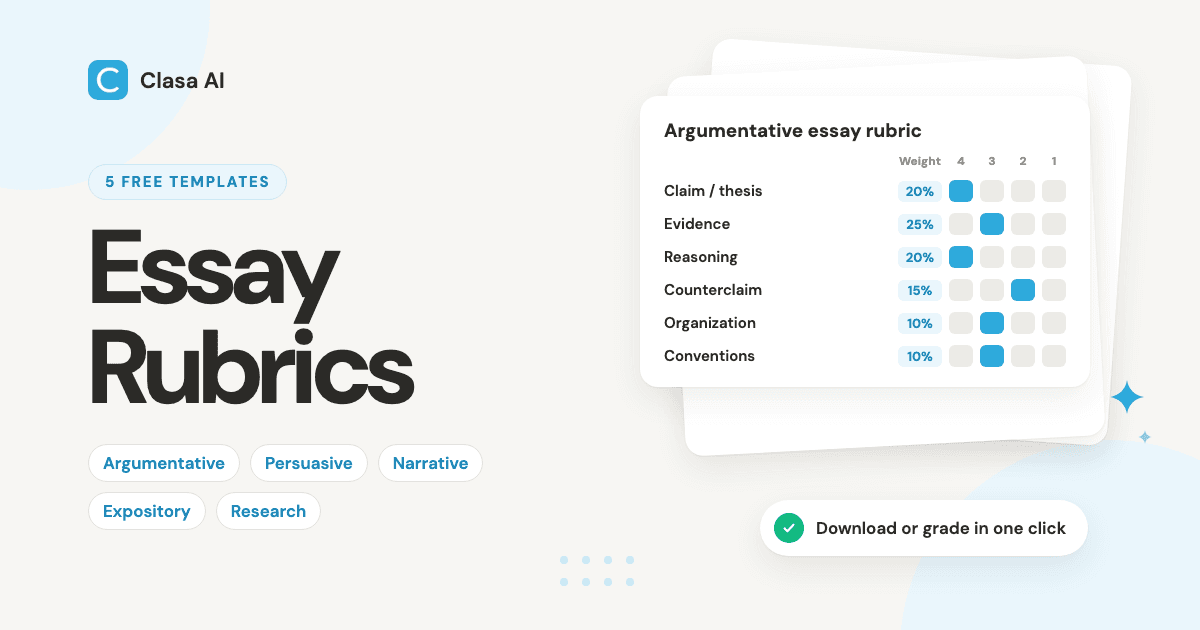
Grading a stack of essays with a vague rubric (or none) takes hours and still feels unfair. A clear essay rubric fixes both: every paper is scored the same way, and students see what good writing looks like.
But one rubric can't fit every assignment. An argument, a personal story, and an explanation ask for different skills, so a rubric for an essay should match the type of writing you assign.
Below are five free essay rubrics: argumentative, persuasive, narrative, expository, and research. Each one shows when to use it, the full table, and a common mistake to avoid.
You can download any of them as Word or PDF, or grade an essay with it in one click. We also show how to adapt each one for middle school, high school, and first-year college.
In this guide
- What should an essay rubric include?
- 5 essay rubrics by type: Argumentative · Persuasive · Narrative · Expository · Research
- Middle school vs. high school essay rubrics
- Common essay rubric mistakes
- How to grade faster with a rubric (and AI)
- Frequently asked questions
What Should an Essay Rubric Include?
An essay rubric should include three things: the criteria you are assessing (such as thesis, evidence, organization, and conventions), a set of performance levels (usually four), and a clear descriptor for each criterion at each level. Strong rubrics also assign weights so higher-order skills like argument count more than mechanics.
Most academic essay grading rubric criteria cover these six areas:
- Thesis or central claim: Is it clear, specific, and arguable or informative, as the task requires?
- Evidence and support: Are the facts, quotes, and examples relevant, sufficient, and accurate?
- Analysis and reasoning: Does the writer explain how the evidence supports the point?
- Organization: Do ideas follow a logical order, with transitions and an introduction and conclusion that do real work?
- Style and voice: Do word choice, sentence variety, and tone suit the audience?
- Conventions: Are grammar, spelling, punctuation, and citations (where needed) correct?
The Four Parts of a Rubric
Criteria say what you assess. For an argument, that might be thesis, evidence, and counterclaims. For a narrative, it might be plot, character, and voice.
Performance levels show how well the student did. Four levels work for most classrooms:
| Score | Level | What it means |
|---|---|---|
| 4 | Exemplary | Meets the standard fully and consistently |
| 3 | Proficient | Meets the standard |
| 2 | Developing | Partly meets the standard |
| 1 | Beginning | Does not yet meet the standard |
Descriptors explain what work at each level looks like, so a 3 and a 2 are easy to tell apart.
Weights set how much each criterion counts. In an argumentative essay, evidence might be 25% of the grade and conventions 10%, so the score reflects what the assignment actually teaches.

Analytic, Holistic, and Single-Point Rubrics
Rubrics come in three common formats (the University of South Carolina's teaching center has a good overview):
| Format | How it works | Best for |
|---|---|---|
| Analytic | Scores each criterion separately | Detailed feedback on specific skills |
| Holistic | Gives one overall score for the whole essay | Quick judgments, such as timed writing |
| Single-point | Describes only the expected standard, with space for comments above or below it | Drafts and writing conferences |
For most classroom essays, an analytic rubric works best because it shows students exactly what to work on. It takes a little longer to score, so save holistic rubrics for quick checks.
Here are two rows of an analytic rubric. Each row is scored on its own:
| Criterion | Proficient (3) | Developing (2) |
|---|---|---|
| Thesis | States a clear thesis that guides the whole essay | States a thesis that is too broad or unclear to guide the essay |
| Evidence | Uses relevant evidence and explains how it supports the point | Uses little evidence and rarely explains it |
Whatever format you choose, check that the descriptors match the assignment. Don't score students on a skill you never asked for, and leave room for a comment when an essay doesn't fit neatly into one level.
5 Essay Rubrics by Type (and When to Use Each)
All five rubrics use the same four levels: Exemplary (4), Proficient (3), Developing (2), and Beginning (1). The criteria and weights change with the type of essay. Each table is the high school version. Rows marked * have a middle school note below the table.
How to turn levels into a grade: for each row, divide the level by 4 and multiply by the weight. A 3 on a 20% row earns 15 points, and a 4 on a 25% row earns 25. Add the rows for a score out of 100.
Note that all 3s add up to 75%, even though 3 means the student met the standard. Many teachers use a conversion chart (for example, mostly 3s = B) rather than reading the total as a percentage. If a student doesn't attempt a criterion, score it 0.
1. Argumentative Essay Rubric
Use this argumentative essay rubric when students must take a position on a debatable issue, defend it with evidence and reasoning, and answer the other side. It fits grades 6–12 and first-year composition.
It follows the Common Core argument writing standard (W.1). It also overlaps with the AP Lang rubric, although AP scores essays on its own 6-point scale.
| Criterion | 4 – Exemplary | 3 – Proficient | 2 – Developing | 1 – Beginning |
|---|---|---|---|---|
| Claim / thesis (20%) | States a precise, arguable claim that previews the reasoning and holds throughout | States a clear, arguable claim that holds through most of the essay | States a claim that is too broad or shifts partway through | States no clear claim, only a topic or a fact |
| Evidence and support (25%) | Uses relevant, credible, and sufficient evidence, accurately quoted and introduced | Uses relevant, credible evidence for most points, with minor gaps | Uses limited evidence, or some that is weak or off-topic | Uses little or no evidence and relies on opinion |
| Reasoning and analysis (20%) | Explains how each piece of evidence proves the claim, with no gaps in logic | Explains how most of the evidence supports the claim | Summarizes evidence more than explaining how it supports the claim | Lists evidence without explaining how it connects to the claim |
| Counterclaim and rebuttal (15%)* | Presents a strong opposing view fairly and refutes it with evidence | Names an opposing view and answers it with a reason | Mentions an opposing view but doesn't answer it | Ignores opposing views |
| Organization (10%) | Ideas build in a purposeful order; the conclusion extends the argument | Ideas follow a logical order with clear transitions | Order is hard to follow in places; few transitions | No clear order; the argument is hard to follow |
| Language and conventions (10%) | Formal, precise tone; errors are rare and never obscure meaning | Mostly formal tone; a few errors that don't affect meaning | Tone slips into casual; errors sometimes distract | Frequent errors make the meaning hard to follow |
* Middle school: in grade 6, counterclaims are optional, so add their 15% to Reasoning. In grades 7–8, keep a simple version: the student names the other side and says why it's weaker.
Common mistake: treating the counterclaim as optional in high school. Answering the other side is what turns an opinion into an argument.
Download: Download the argumentative essay rubric (Word or PDF). It opens in our free rubric maker, so you can edit it first.
Grade with this rubric: Grade an argumentative essay with this rubric
2. Persuasive Essay Rubric
Use this persuasive essay rubric when the goal is to move a specific audience to agree or act, as in speeches, op-eds, letters, and debate units. It fits grades 6–10.
Unlike an argumentative essay, a persuasive piece can lean on emotional appeals and doesn't need a formal counterargument. Common Core covers persuasive purposes under its argument standard in grades 6–12, but it favors logic and evidence over emotional appeal, so use this rubric when appealing to the audience is the lesson.
| Criterion | 4 – Exemplary | 3 – Proficient | 2 – Developing | 1 – Beginning |
|---|---|---|---|---|
| Position statement (20%) | States a clear, confident position early and keeps it throughout | States a clear position that holds through most of the essay | States a position that is vague or wavers | Takes no clear position |
| Persuasive appeals and techniques (20%) | Combines credibility, emotion, and logic (ethos, pathos, logos) with well-chosen devices | Uses at least two kinds of appeal and some devices that fit the purpose | Relies on one kind of appeal; devices feel forced | Uses few or no persuasive appeals or devices |
| Evidence and reasons (20%) | Gives convincing reasons, each backed by relevant facts, examples, or anecdotes | Gives clear reasons, most backed by relevant support | Gives reasons with thin or loosely related support | States opinions with no reasons or support |
| Audience awareness and tone (15%)* | Anticipates the audience's values and concerns; tone fits throughout | Addresses the audience's likely concerns; tone mostly fits | Shows little sense of the audience; tone shifts | Ignores the audience; tone works against the purpose |
| Organization (15%) | Strong hook, reasons ordered for impact, and a memorable call to action | Clear opening, logical order of reasons, and a conclusion | Weak opening or conclusion; order of reasons feels random | No clear opening, order, or conclusion |
| Conventions (10%) | Few or no errors; varied sentences add to the persuasive effect | A few errors that don't affect meaning | Repeated errors that sometimes distract | Frequent errors make the writing hard to follow |
* Middle school: keep this row simple. The student names the intended reader and uses a tone that suits them.
Common mistake: rewarding emotional language with no reasons behind it. Strong feelings alone don't persuade; students still need convincing reasons and support.
Download: Download the persuasive essay rubric (Word or PDF). It opens in our free rubric maker, so you can edit it first.
Grade with this rubric: Grade a persuasive essay with this rubric
3. Narrative Essay Rubric
Use this narrative essay rubric for personal narratives, memoirs, and short fiction in grades 6–12. It follows the Common Core narrative writing standard (W.3).
The focus is storytelling, not a thesis: students bring events, characters, and setting to life and show why the experience matters. College application essays are a different genre with their own goals, so see our guide to reviewing a college essay for those.
| Criterion | 4 – Exemplary | 3 – Proficient | 2 – Developing | 1 – Beginning |
|---|---|---|---|---|
| Plot, structure, and pacing (20%) | Clear sequence with purposeful pacing; any flashbacks or shifts are deliberate | Complete sequence of events with mostly suitable pacing | Events feel rushed, uneven, or hard to follow in places | The sequence of events is unclear |
| Character and point of view (15%) | Develops characters through action, dialogue, and thought; point of view is consistent | Characters are clear; point of view is mostly consistent | Characters are thin; point of view slips | Characters or point of view are unclear |
| Setting and sensory detail (15%) | Vivid, specific details ground the reader in time and place | Relevant details establish the setting | Details are general or sparse | Little or no sense of setting |
| Narrative techniques (15%)* | Uses dialogue and figurative language skillfully to develop events and characters | Uses dialogue or figurative language with some effect | Uses techniques rarely or awkwardly | Uses almost no narrative techniques |
| Theme or significance (15%) | The ending reveals a clear insight or change that stays with the reader | Central idea is clear; the ending fits the story | Central idea is vague; the ending summarizes or stops abruptly | The story has no clear point; the ending is missing |
| Voice, style, and conventions (20%) | Distinct voice; varied sentences; dialogue punctuated correctly | Consistent voice; a few errors that don't affect meaning | Voice is inconsistent; errors recur and sometimes distract | Frequent errors make the story hard to follow |
* Middle school: merge this row into Plot, structure, and pacing, making that row 35%.
Common mistake: grading a narrative like an argument. A personal story doesn't need a thesis or evidence, so score how well the story is told.
Download: Download the narrative essay rubric (Word or PDF). It opens in our free rubric maker, so you can edit it first.
Grade with this rubric: Grade a narrative essay with this rubric
4. Expository Essay Rubric (Informative)
Use this expository essay rubric (also called an informative essay rubric) when students explain a topic rather than argue about it, as in compare-and-contrast, cause-and-effect, and how-to essays in grades 6–12. It follows the Common Core informative/explanatory writing standard (W.2).
It also works as a five-paragraph essay rubric for students who are learning to organize an explanation.
| Criterion | 4 – Exemplary | 3 – Proficient | 2 – Developing | 1 – Beginning |
|---|---|---|---|---|
| Focus and thesis (20%) | States a precise controlling idea and stays focused on explaining it throughout | States a clear topic and stays mostly focused on it | Topic is too broad, or the essay drifts into arguing or off-topic points | No clear topic or controlling idea |
| Development and supporting details (25%) | Develops each point fully with specific facts, definitions, and examples | Develops most points with relevant details | Points are thinly developed, or details are general | Gives too little information to explain the topic |
| Organization and transitions (20%) | Structure fits the purpose (such as compare-contrast); transitions show how ideas connect | Logical structure with clear transitions | Hard to follow in places; transitions are few or repetitive | No clear structure; ideas are hard to follow |
| Clarity and precision of language (15%) | Precise vocabulary and subject terms used correctly; explanations are easy to follow | Clear vocabulary; most explanations are easy to follow | Vague or repetitive wording makes some explanations unclear | Wording makes most explanations hard to follow |
| Use of sources and accuracy (10%)* | All information is accurate; sources are credited where used | Information is mostly accurate; sources are credited | Some inaccuracies, or some sources not credited | Major inaccuracies, or sources not credited |
| Conventions (10%) | Few or no errors; formatting (headings, lists) aids understanding when used | A few errors that don't affect meaning | Repeated errors that sometimes distract | Frequent errors make the writing hard to follow |
* Middle school: if the assignment doesn't use outside sources, merge this row into Development and supporting details, making that row 35%.
Common mistake: making the five-paragraph form the goal. Score how well students develop and explain their ideas, not the number of paragraphs.
Download: Download the expository essay rubric (Word or PDF). It opens in our free rubric maker, so you can edit it first.
Grade with this rubric: Grade an expository essay with this rubric
5. Research Essay Rubric
Use this research essay rubric (it works as a research paper rubric too) when students must find, evaluate, and synthesize several sources and cite them in MLA or APA. It fits grades 9–12 and first-year college and follows the Common Core research standards (W.7–W.9).
Research papers can explain or argue, so this rubric adds source and citation rows to the core of the expository and argumentative rubrics. For middle school research projects, use the expository rubric above, which already has a sources row.
| Criterion | 4 – Exemplary | 3 – Proficient | 2 – Developing | 1 – Beginning |
|---|---|---|---|---|
| Research question and thesis (15%) | A focused question leads to a thesis that synthesizes the sources rather than reporting them | A relevant question leads to a clear thesis | The question is broad, and the thesis mostly reports information | No clear question or thesis |
| Quality and variety of sources (20%) | Varied, credible sources (scholarly where expected), each evaluated rather than taken at face value | Mostly credible, relevant sources of more than one type | Few sources, or some of doubtful credibility | Relies on one or two unreliable sources |
| Integration of evidence and analysis (25%) | Introduces and quotes or paraphrases sources accurately; analysis leads and the writer's voice is clear | Introduces sources and explains how most evidence supports the thesis | Drops in quotes with little introduction or analysis | Strings sources together with no analysis |
| Organization (15%) | Clear section logic; ideas build toward the conclusion | Clear structure with a mostly logical order | Structure is hard to follow in places | No clear structure; sections feel disconnected |
| Citation and formatting (15%) | In-text citations and works cited are complete and correct in the required style | Citations are complete, with minor format errors | Some sources not cited, or repeated format errors | Citations are missing or inconsistent |
| Conventions and academic style (10%) | Objective, precise academic tone; errors are rare | Mostly academic tone; a few errors that don't affect meaning | Tone slips into casual; errors sometimes distract | Frequent errors and a casual tone make it hard to follow |
Common mistake: weighting MLA or APA format above analysis. That's why integration and analysis carries the most weight here (25%) and conventions only 10%.
Download: Download the research essay rubric (Word or PDF). It opens in our free rubric maker, so you can edit it first.
Grade with this rubric: Grade a research essay with this rubric
Middle School vs. High School Essay Rubrics (and First-Year College)
Match the rubric to your students' experience. Middle schoolers need short, plain descriptors. High school and college writers are expected to analyze, reason on their own, and handle sources.
| Area | Middle school | High school | First-year college |
|---|---|---|---|
| Criteria | 5 | 5–6 | 5–6 |
| Descriptor language | Plain "I can" statements | Academic and specific | Precise and discipline-specific |
| Thesis or claim | States a clear claim or main idea | States a defensible thesis | Argues a complex, qualified thesis |
| Evidence | Uses relevant examples and facts | Uses credible sources | Synthesizes and evaluates sources |
| Counterclaims | Optional in grade 6; named and answered in grades 7–8 | Fairly presented and refuted | Weighed in depth, with concessions |
| Organization | Clear beginning, middle, and end | Logical progression with transitions | Structure shaped by the argument |
| Scoring | Points out of 20 | Weighted percentages or points | Weighted percentages |
For middle school, rewrite each descriptor as an "I can" statement students can check themselves. Here's the claim row:
- 4 – Exemplary: I state a clear claim and support it with details throughout.
- 3 – Proficient: I state a clear claim and support it with some details.
- 2 – Developing: My claim is there, but it's unclear or has little support.
- 1 – Beginning: I don't have a clear claim yet.
Five criteria at four points each give a simple score out of 20.
Treat these grade bands as starting points. A middle school source-based assignment may need a simple sources row, and a high school narrative may need more weight on voice and pacing. Let the assignment's goals set the criteria.
For first-year college writing, put more weight on analysis, source evaluation, and independent reasoning. Name the citation style you expect so students don't have to guess.
Common Essay Rubric Mistakes (and How to Fix Them)
- Vague descriptors. "Good organization" means different things to different graders. Describe what you'd see instead: "Each paragraph opens with a topic sentence, and transitions show how ideas connect."
- Too many criteria. Ten rows slow grading and blur the feedback. Four to six is enough for most essays, so merge related skills, like spelling and punctuation, into one conventions row.
- Weights that don't match the task. If argument is the point, it should count more than mechanics. If students didn't use outside sources, source quality shouldn't count at all. And check that the weights add up to 100.
- Levels that differ only by adjectives. "Excellent, good, fair, poor" tells students nothing. Each level should say what the writing does, such as "explains how the evidence supports the claim" versus "summarizes the evidence."
- No student-friendly version. If students can't read the rubric, they can't use it. Rewrite the descriptors as "I can" statements, especially in middle school.
- Sharing the rubric after grading. A rubric works best as a guide while students plan, draft, and revise. Hand it out with the assignment.
- No calibration. Two teachers can give the same essay different scores. Score a few sample essays together before grading a full set to keep scores consistent (inter-rater reliability).
How to Grade Faster with a Rubric (and AI)
Grading a class set goes faster when you follow the same routine for every essay instead of scoring on overall impression:
- Share the rubric early. Students who plan with it make fewer of the mistakes you'd otherwise comment on.
- Grade one criterion at a time. Read every thesis in the class set first, then move on to evidence and organization.
- Keep anchor papers at hand. Pick one scored essay for each level and compare against it when you're unsure.
- Build a comment bank. Write a few standard comments for common problems, then personalize them for each student.
This keeps your scores consistent and stops the quality of one essay from changing the score of the next.
Using AI for Rubric-Based Grading
An AI essay grader with rubric support can draft criterion scores and feedback for you. With Clasa AI, it takes four steps:
- Paste or upload the student's essay.
- Choose a rubric: one of the five above, another ready-made one, or your own file.
- Review the suggested score and feedback for each criterion.
- Edit any score or comment that doesn't match what the student wrote.
The AI drafts; you decide. Review every result and own the final grade, because the AI can't know every classroom instruction or accommodation.
To start, run a few essays you've already graded through it. Compare its scores with yours and adjust the rubric wording where they differ. Unclear criteria show up fast this way.
Need a rubric for a different assignment? Clasa's free AI rubric maker builds one from a short description, and you can edit and download it.
Frequently Asked Questions
What should an essay rubric include?
An essay rubric should include clear criteria, performance levels, and descriptors that explain what each level looks like. It should also assign weights to show how much each criterion contributes to the final grade. Common academic essay grading rubric criteria include thesis, evidence, analysis, organization, style, and conventions.
What is the difference between an argumentative and a persuasive essay rubric?
An argumentative essay rubric focuses on evidence-based reasoning, a defensible claim, and the response to opposing views. A persuasive essay rubric focuses more on audience awareness, rhetorical techniques, and emotional appeals. Persuasive writing does not always require a formal counterargument, but the reasons supporting the position should still be convincing.
How many criteria should an essay rubric have?
Four to six criteria are enough for most assignments. Middle school teachers may use fewer categories and simpler descriptions, while advanced high school and college assignments may need dedicated criteria for research, analysis, or citation. Adding too many categories can make grading slower without giving students more useful feedback.
Should I use a 4-point or 5-point scale?
A four-point scale has no middle score, so you have to decide whether work meets the standard or not. A five- or six-point scale allows finer distinctions. AP English essays, for example, are scored 0–6. Either works if the descriptors are clear, and using the same scale across assignments matters more than the number.
What is a good rubric for grading essays in high school?
A good high school rubric covers thesis, evidence, reasoning, organization, and language and conventions, weighted toward the skills the assignment teaches. The argumentative and research rubrics above are good starting points, and research papers add rows for source quality and citations. Use a rubric that fits each type of writing rather than one for everything.
Is there a rubric for a five-paragraph essay?
Yes. The expository rubric above works for five-paragraph essays. It scores the controlling idea, supporting details, organization and transitions, language, and conventions. Treat the five-paragraph form as a scaffold, not the goal, and give credit for clear explanation and well-developed support rather than a paragraph count.
Can AI grade essays with my rubric?
Yes. Clasa reads a rubric you upload (Word, PDF, spreadsheet, image, or text) or one you pick from its ready-made list. It then suggests a score and feedback for each criterion. You review and edit every result before it goes back to students, so the final grade stays yours.
How do I make my own essay rubric?
Start with the assignment's learning goals. Choose four to six criteria, set your performance levels, and write a descriptor for each criterion at each level. Weight the criteria by importance, then test the rubric on a few sample essays. Our guide on how to make a rubric walks through each step, or Clasa's free AI rubric maker can draft one for you.
Start Grading with Your Rubric
A clear rubric makes grading fairer and shows students what you expect. Pick the template that fits your assignment, edit it if you need to, and share it before students start writing.
When you're ready to grade, open the essay grader. It's free to try, works with any rubric, and drafts criterion-by-criterion feedback in seconds. You make the final call on every grade.