
AP Lang Rubric 2026: Synthesis, Rhetorical Analysis & Argument
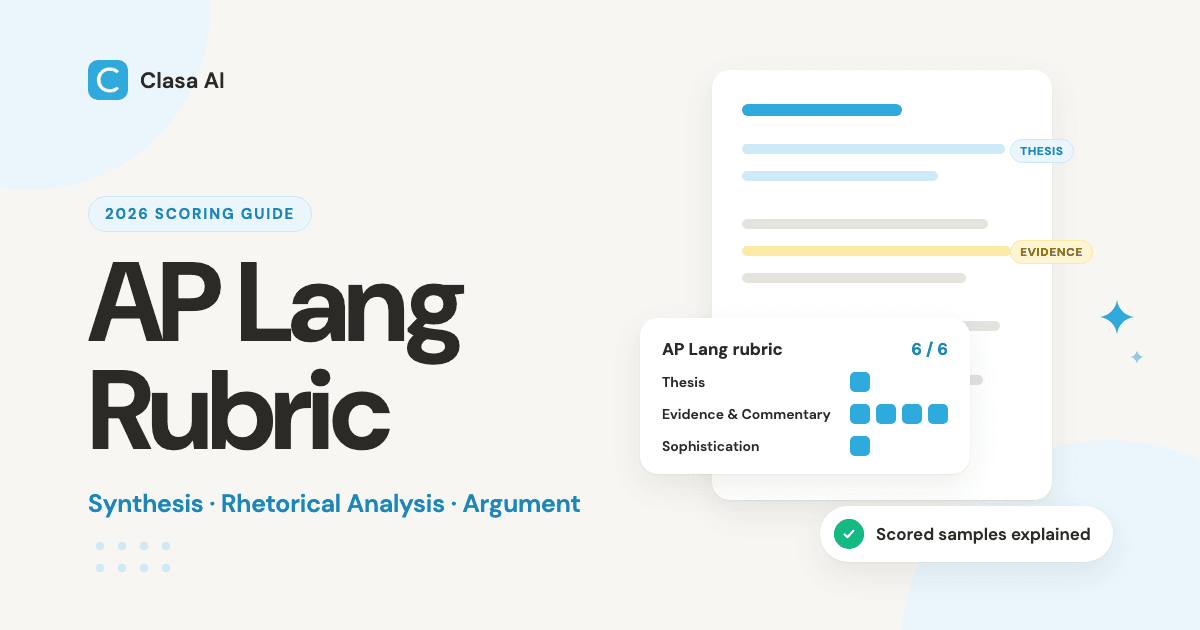
The AP Lang rubric assigns a score of up to six for each of the three free-response essays: synthesis, rhetorical analysis and argument. One point is given for the thesis, as many as four for evidence and commentary and one for sophistication. This free-response portion makes up 55% of the overall AP English Language and Composition exam grade. The 2026 scoring guidelines keep this six-point format in place for students preparing for the May 12, 2027 exam.
AP English Language Essay Rubric at a Glance
Every essay is scored on its own merits from three rows on the rubric. While the structure remains the same, the required evidence varies with the task. Synthesis requires supplied sources; rhetorical analysis focuses on the writer’s choices; and an argument requires students to present relevant evidence to defend a position.
| Rubric category | Points available | What earns the points |
|---|---|---|
| Thesis (Row A) | 0–1 | A defensible claim in response to the prompt |
| Evidence and commentary (Row B) | 0–4 | Specific evidence with a clear line of reasoning |
| Sophistication (Row C) | 0–1 | Nuanced thinking or a style that is consistently vivid and persuasive |
| Total per essay | 6 |
In two hours and 15 minutes, which includes 15 minutes for reading, students complete the three essays of the free-response section. The multiple-choice part comprises the other 45% of the total score. Time management is something to practice, ensuring you leave enough time to fully develop and convey your ideas. For the format of the exam, refer to the College Board’s official AP English Language and Composition exam information.
Knowing the scoring criteria will help you focus on the skills that earn points rather than just writing at length. The thesis sets out your position, evidence and commentary build the case, and sophistication shows you have given the issue or rhetorical situation some thought.
AP Lang Synthesis Essay Rubric
Six sources are put before the student for the synthesis essay in the form of written passages, charts, graphs or other materials. Students must use at least three sources to support a position, but that alone won't earn a high mark for evidence and commentary; they must make the connection between the information and their claims clear. The 2026 prompt, which asked students to develop a position on the value, if any, of napping, is a good way to get at this skill. Students should form their own defensible stance after reviewing the sources instead of parroting their conclusions. The original prompt can be found in the official 2026 free-response questions.
A well-done synthesis essay will:
- Put forward a defensible thesis that answers the prompt.
- Make use of at least three sources, picking information that goes directly to the argument.
- Offer an explanation of the evidence so the reader does not have to make the link.
- Have a line of reasoning where the paragraphs are arranged to further the central point.
- Acknowledge complexity such as limitations or competing views when called for.
Take a student who writes about napping. They might contend that short naps aid alertness but only in certain routines and according to individual need. The argument is theirs to make with the source evidence to support it, not a run-through of the sources. To practice, grade a synthesis essay with the AP Lang synthesis rubric.
Synthesis Essay Rubric: What Earns Each Point
The table below is for the evidence and commentary row in synthesis; the thesis and sophistication are handled separately.
| Evidence and commentary points | What earns the points (synthesis) |
|---|---|
| 0 | Restating the thesis or provided information, or using fewer than two sources. |
| 1 | At least two sources used but for the most part summarized. |
| 2 | Three or more sources with some explanation of the evidence, yet no clear line of reasoning. |
| 3 | Every claim is backed by specific evidence from at least three sources; some of the evidence is commented on. |
| 4 | As above, but the commentary consistently shows how the evidence supports the reasoning. |
That consistency is what separates a three from a four. With three points, the evidence may be there for every claim, but the commentary explains only some of it. Four means the connection to the argument is made all along. The thesis point requires a defensible answer to the prompt, and the sophistication point demands either meaningful complexity or a persuasive style. Good use of sources does not in itself ensure either.
When practicing, have the College Board’s official scoring guidelines and free-response questions and this table on hand. Use the official rubric as the last word in evaluating a response. Before turning in a practice essay, go over the thesis, the sources chosen, the commentary and the reasoning.
AP Lang Rhetorical Analysis Essay Rubric
This essay is an exercise in explaining how a writer’s rhetorical choices serve to make an argument or accomplish a purpose. It is not about deciding whether the writer is correct. You have to explain how the choices function in context and contribute to the message.
For practice, the 2026 rhetorical analysis prompt is instructive: it asked students to analyze the rhetorical choices Laura Amy Schlitz makes in her Newbery Medal acceptance speech to communicate what it is to be a writer. Read the passage and prompt in the official 2026 questions first. Say you spot a speaker employing repetition for emphasis. To name the repetition is not enough. You have to say what it emphasizes, its effect on the audience, and why it serves the speaker’s end.
Consider the difference:
- Weak commentary: The speaker uses repetition to make the speech interesting.
- Stronger commentary: By hammering home the central idea, the speaker makes its importance plain and prompts the audience to see how it fits with the speech's larger message.
The second statement ties the rhetorical choice to its purpose; that is what separates analysis from mere identification of technique.
What is required for evidence and commentary points? In rhetorical analysis, the line between three and four is fine.
Three points are given when specific evidence supports every claim, the commentary explains some of it, and the essay shows how at least one rhetorical choice serves the writer’s purpose. To get four, the commentary must explain the evidence consistently, for every claim, and show how multiple rhetorical choices serve that purpose. The same choice used repeatedly can count if each instance adds something of substance.
Students have to put forward specific textual evidence and make clear why it matters. It is not enough to name imagery, tone, repetition, or direct address. A good example is a speaker who uses a personal story to bond with the audience before turning to a contrast to test an assumption. Strong commentary will show how each move advances the message and, as the case may be, how they work together.
Grammar is no small matter. Errors that stand in the way of communication will bar a response from the fourth point on any of the three essays. Writing that is easy to read lets the reader track the analysis and the link between the evidence and the purpose.
To try this on your own draft, grade a rhetorical analysis essay with the AP Lang rubric.
AP Lang Argument Essay Rubric
With the argument essay, you do not have a packet of sources to draw on as in synthesis. You take a position on the prompt and back it up with whatever relevant evidence comes from your reading, history, or other appropriate knowledge.
The 2026 prompt, which asked students to argue the extent to which Mae Jemison’s claim about considering others’ opinions is valid, is a good illustration. The student has to interpret what is being put forward and build a defensible case, not just offer a bare agreement or disagreement. An argument on independent decision-making might acknowledge the value of advice but argue that the individual must weigh it before acting. This stance allows you to consider competing values while keeping the main claim in view.
A sound paragraph structure would be:
- Put forward a claim and give a reason for your thesis.
- Offer a concrete example from history, literature, a public figure or your own observations.
- Make the case for why the example is significant.
- Tie it back to the thesis so the overall argument is advanced.
Listing famous names is less effective than working through one example in depth. The evidence is for the reader to consider; the commentary tells them what it shows. When you have a draft, grade an argument essay with the AP Lang rubric.
How to Develop a Defensible Argument
Sweeping claims unsupported by evidence have no place in a strong essay. If one argues that independent decision-making matters, the essay should explain when it is useful and include an example to prove it.
A student who says people ought to disregard outside advice is hard to follow; expert guidance can stave off mistakes. A stronger thesis would be that while people should think carefully about advice, they remain responsible for the decision. This doesn't dilute the argument; it refines it and leaves room to address other values. If this kind of complexity is woven through the response and not tacked on as a token counterargument, the sophistication point is within reach.
How to Earn the Sophistication Point
It is a single point, but it's not handed out for sounding erudite. The College Board wants to see sophisticated thought, an intricate grasp of the rhetorical situation, or a style that is vivid and persuasive all the way through. Complexity for its own sake, in the form of long sentences or a few fancy words, will not do.
Sophistication Point Checklist
When going over a practice essay:
- Build a complex argument (synthesis and argument essays). Do not treat the issue as a simple either/or.
- Put competing values on the table and explain what they mean.
- Be aware of limitations in your argument or where the evidence needs some qualification.
- For rhetorical analysis, show how the writer’s context and audience inform the choices at hand.
- Employ a style that is both vivid and persuasive.
Not every item is necessary for the point. What is needed is a consistently vivid and persuasive style or meaningful complexity.
What Doesn't Earn the Sophistication Point
Some things may have the ring of sophistication without meeting the rubric:
- Openings like “In a world where...” are broad and do little to develop an argument.
- A “While some may argue...” is only a token counterargument unless the other side is properly examined.
- If long sentences and vocabulary get in the way of the argument, they are of no use.
- In rhetorical analysis, picking out choices one by one without showing how they interrelate falls short of a sophisticated understanding.
It is the effective development of ideas that counts, not how convoluted the writing is. A clear argument that addresses an important tension is better than elaborate language with little reasoning behind it.
Scored Examples: Sample 2A (6) and Sample 2B (4)
The official College Board samples show how two answers to the same prompt can be scored differently, even when both make relevant observations. In the 2025 Set 1 rhetorical analysis, students were asked to examine the argument David Treuer makes at the opening of Rez Life (2012) about Native American contributions to the U.S. and to analyze his choices in doing so. The task was not to identify the subject or summarize it, but to explain how his rhetoric builds the case. A review of the official 2025 Set 1 student work and scoring commentary will put this in perspective.
Sample 2A: A Six-Point Response
With a score of 1-4-1, Sample 2A earned all six points.
- Thesis (1): It offers a defensible read on Treuer’s rhetorical choices.
- Evidence and commentary (4): Specifics from the text are put to use to show how the writer’s argument is made.
- Sophistication (1): The response explains a tension in the passage: Americans acknowledge Native Americans yet often hold a misleading picture of their lives. The College Board’s commentary points to this line: “This shows how Americans do acknowledge Indians but often have a false narrative.”
Notice that Sample 2A's prose is plain. It makes no attempt to impress with vocabulary, and it still scored a six because it ties evidence to the writer’s intent and offers a considered interpretation.
Sample 2B: A Four-Point Response
This sample scored 1-3-0 for a total of four.
The fourth point for evidence and commentary was not awarded because the piece did not sufficiently link Treuer’s direct address to the reader to his purpose. Spotting the technique is not enough; the writing has to show how it serves the argument.
The comparison is a clear example of a common shortcoming in rhetorical analysis. A student might choose the right evidence, but if the commentary doesn't explain why it matters, the score will suffer.
Lessons for Students From the Comparison
- Thesis: Put forward an interpretation that stands up to scrutiny.
- Evidence: Be specific in the details you select.
- Commentary: Make clear how those details further the writer’s purpose.
- Sophistication: Aim for a nuanced understanding, not just complicated language.
Before trying the question on your own, go over both samples. See how Sample 2A makes the connection to Treuer’s purpose and then measure that against the weaker link in Sample 2B. It is not a matter of the quantity of evidence but the effectiveness of the explanation.
Grade with this rubric: run a practice essay through the AP Lang rubric for synthesis, rhetorical analysis or argument and see which row needs work.
AP Lang Feedback Comments for Teachers
Use the following when grading practice essays. Organizing feedback by rubric row lets the student know whether the thesis, evidence and commentary, or sophistication needs work.
Row A: Thesis
- Missing or unclear thesis: Your response must have a defensible claim in answer to the prompt.
- Thesis too broad: Put a finer point on your position for the reader.
- Thesis lacks a clear position: Be more specific so the rest of the essay has direction.
Row B: Evidence and Commentary
- Insufficient evidence: Support your claim with something more concrete.
- Summary instead of analysis: Do not restate the evidence; explain what it means for your reasoning.
- Weak line of reasoning: Every paragraph should move the overall argument along.
- Sources treated separately: Show how your sources relate to each other and to your position.
- Rhetorical choices identified but unexplained: Indicate how the writer’s decisions serve the intended purpose.
- Example lacks relevance: Make the case for why your example is there and how it supports you.
- Communication problems: Some sentences need revision for clarity.
Row C: Sophistication
- Oversimplified argument: Look for a tension or competing value in your position.
- Token counterargument: Give the alternative view some development and say how it bears on your reasoning.
- Unnecessary complexity: Language should be purposeful, not complex for the sake of it.
- Disconnected rhetorical analysis: Show how the writer’s various choices build the argument.
- Limited discussion of context: Factor in the audience, situation, and purpose.
Telling a student to “add more detail” is not as helpful as being specific about what part of the response is wanted and what can be done in the next draft.
For a wider look at writing criteria, see our guide on how to make a rubric.
Grade a Class Set With the AP Lang Rubric
Scoring several practice essays is time-consuming, especially when judging thesis, evidence, commentary, and sophistication on their merits. An AI essay grader with rubrics can do some of the legwork by pointing out weaknesses according to set criteria.
Use the grader to run practice responses through the six-point system. For AP English Language work, the menu will include the appropriate rubric, whether for Synthesis, Rhetorical Analysis, or Argument. Select the relevant preset from the rubric menu: AP English Language Synthesis, AP English Language Rhetorical Analysis, or AP English Language Argument. The tool can flag a thesis that needs clarification, commentary that is little more than summary, or evidence that isn't well tied to the argument.
The AP Lang AI grader is meant to be an aid for practice and revision, not a substitute for the official College Board scoring or a teacher’s own judgment. When reviewing a response, verify that the feedback shows a defensible thesis, identifies shortcomings in the commentary or evidence, and distinguishes between merely pointing out rhetorical choices and explaining what they are for. Consider the output a place to begin your review, not an official score from the College Board. For what the research says, see our overview of how accurate automated essay scoring is.
For a rubric suited to a particular assignment in the classroom, it is possible to build your own rubric. A custom version can set expectations for revision exercises and writing activities with greater clarity.
Grade a Class Set in 20 Minutes
A steady review process will simplify handling a large batch of practice essays. Start by going over the three scoring rows instead of trying to put right every sentence.
- The thesis: See if the student has put forward a claim that is defensible in answer to the prompt.
- Evidence and commentary: Does the response have the relevant evidence, and does it make clear how that evidence underpins the reasoning?
- Sophistication: Go beyond complicated vocabulary to find a vivid, persuasive style, or add meaningful nuance.
- Put down the next step: Assign a single revision priority to each student.
This 20-minute workflow is an organizational target for an initial run through the class set, not a promise that every essay can be completely graded in the time allowed. The length of the piece, class size, and how much feedback is required will all affect it. Before making any instructional decisions, any scores put out by the AI ought to be measured against the official guidelines. Students working on their own can follow the same procedure: turn in a draft, look at the feedback, and work on revising one area at a time.
Grade with this rubric: open the AI essay grader with the AP Lang preset for synthesis, rhetorical analysis or argument. Or build your own rubric to make a scoring guide for a classroom assignment.
Frequently Asked Questions
How Is the AP Lang Exam Scored?
There are two parts to the AP English Language and Composition exam. Multiple choice makes up 45% of the total; the three free-response essays make up the other 55%. Each is scored out of six: one point for the thesis, as many as four for evidence and commentary, and one for sophistication.
How Many Sources for the Synthesis Essay?
While the prompt gives six, a minimum of three must be used to back a position. But three sources do not in themselves ensure a high mark. The evidence has to be relevant, and the student must explain its support for the reasoning.
What About the Sophistication Point?
It is earned by showing a complex grasp of the argument or rhetorical situation, some nuance of meaning, or a consistently persuasive style. A long introduction or difficult words will not do it, nor will a token counterargument.
Do Grammar Errors Come at a Cost?
They do when they get in the way of communication. Under the rubric, such errors will bar an essay from the fourth point for evidence and commentary. Clear sentences and logical paragraph development should be the priority so the reader can follow the explanation.
Is the Rubric the Same for the Three Essays?
The six-point structure applies to the argument, rhetorical analysis, and synthesis, but the demands for evidence and commentary vary. Synthesis calls for use of the supplied sources, rhetorical analysis for an account of the writer’s choices, and argument for a defensible case with supporting evidence.
Any Changes to the Rubric in 2026?
The six-point format is still in place for the 2026 guidelines. Those getting ready for the May 12, 2027, test may work with the 2026 prompts and older questions using this framework. For the most current examples and documents, refer to the College Board’s official materials.
Conclusion: Make the Most of the AP Lang Rubric
The rubric gives students a practical way to improve their work. The thesis states your position; the evidence and commentary flesh out your reasoning, and sophistication adds complexity or vividness.
Take each row in turn. Does the thesis address the prompt? Is the evidence there to back the claims, and does the commentary make a case for why it is important? With a synthesis essay, show the sources forming a coherent line of argument. In rhetorical analysis, link the purpose to the writer’s choices. And in an argument, put forward a position with specific examples.
Looking at official student samples is a good way to see the criteria in action and spot the variance in reasoning and evidence between different scores. An AI grader can help you find weaknesses, but you should hold the feedback to the College Board standard before accepting it. Use the AI tool with the proper preset to review your next practice piece or put together a rubric of your own for a custom job. Grade with the AP Lang rubric or build your own rubric.