
Automated Essay Scoring: How AI Is Changing Writing
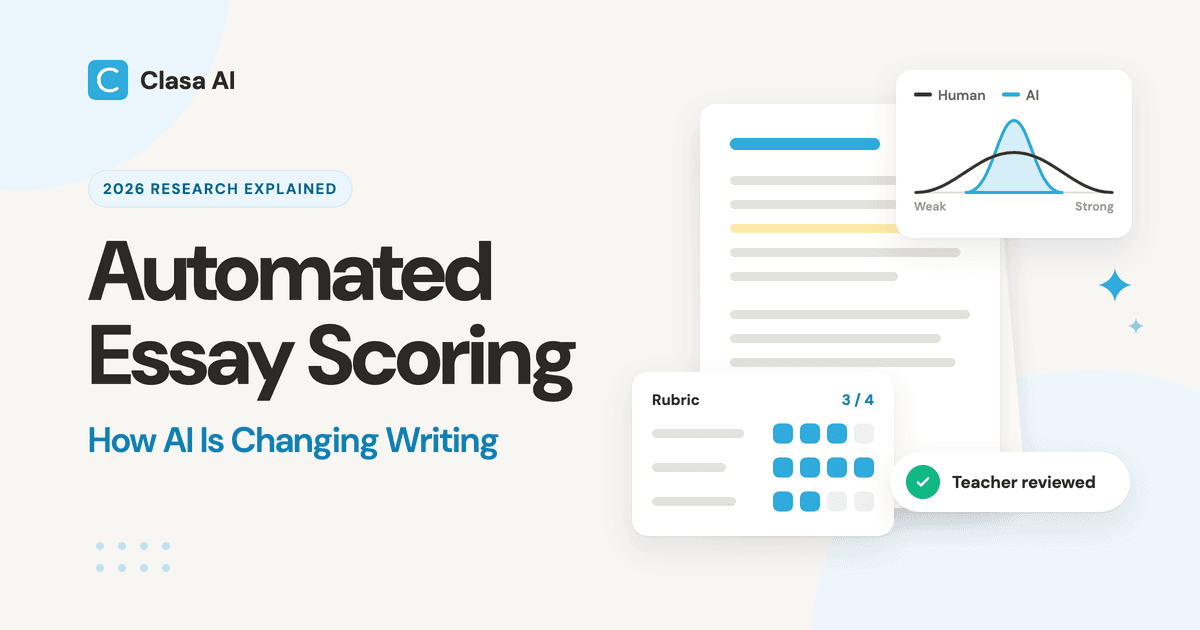
Automated essay scoring uses AI to read an essay, check it against a rubric, and return a score and feedback in seconds. Research from 2026 shows AI can agree with human graders on some tasks, but it scores differently from people and struggles with very weak and very strong writing. For teachers, it works best as a first-pass and revision tool, not a replacement for human grading.
Clasa builds a rubric-based AI essay grader, so we pay close attention to this research, and we cite it rather than treat our own tool as the benchmark. Below is what the latest studies actually say about AI essay grading, including its strengths and its limits.
What Is Automated Essay Scoring?
Automated essay scoring (AES) uses AI, machine learning, or natural language processing to assess written work against a set of criteria or a rubric. The system scores an essay so a teacher does not have to complete every first pass by hand. Depending on the tool, it may look at grammar, vocabulary, structure, content, and how well the essay answers the assignment.
Automated essay scoring is not new. Project Essay Grade (PEG) used computer analysis of writing as far back as the 1960s, and ETS e-rater has been used for automated writing assessment for decades. Newer systems use neural networks and large language models (LLMs), which lets them work with meaning and detailed scoring criteria rather than only basic language patterns.
Modern AI essay scoring is not just counting words or flagging errors. It can evaluate several aspects of an essay at once, which is why it helps to separate it from the tools it is often confused with.
| Tool | Main job | What it provides | Typical user |
|---|---|---|---|
| Grammar checker | Find language errors | Spelling, grammar, punctuation, and wording suggestions | Students and writers |
| Automated writing evaluation (AWE) | Help writers improve | Feedback on organization, language, and development | Students and teachers |
| Automated essay scoring (AES) | Score writing against a rubric | A score and, depending on the tool, feedback on each criterion | Teachers and schools |
The main difference is purpose. A grammar checker fixes language problems, AWE helps writers improve, and AES assesses an essay against defined scoring criteria and produces a score.
How Does an AI Essay Grader Score Writing?
The mechanics vary by model, but an AI essay grader typically weighs a mix of language, structure, content, and rubric criteria.
Grammar and Language
AI reliably catches spelling mistakes, punctuation errors, and weak word choice, and these features are useful for gauging proficiency. But flawless grammar does not make a good essay if the ideas are thin or the evidence is missing. A useful AI writing assessment tool has to look beyond the surface.
Organization and Coherence
The grader can also assess whether an essay presents its points coherently. It can check whether the introduction sets up the topic, whether the paragraphs follow a logical order, and whether the conclusion connects back to the main argument.
This is an area where generative AI does comparatively well. In a study of 1,768 grade 3–4 essays, Huang, Palermo, and Wilson (2026) found that a well-prompted GPT-4o aligned more closely with human raters on organization and style, while an older feature-based scoring engine aligned better on development of ideas and surface-level traits.
Content and Development
Grading the substance of an essay is harder. An opinion is not enough; it needs development and supporting detail. An LLM can be asked to assess these areas with a rubric, but its judgment may differ from a human reader's.
Wang, Chen, Huang, and Lai (2026) compared Qwen, GPT, and Gemini with human raters on essays by non-native English writers. The models placed more weight on grammatical accuracy, vocabulary, and sentence complexity. Human raters placed more weight on whether the content was complete, paid attention to visual presentation, and were more tolerant of minor language errors. Their scoring was also more stable across students' proficiency levels.
Prompt and Rubric Alignment
A sound AI essay grader also checks that the student actually answered the prompt. If the rubric asks for an explained argument or supporting evidence, the AI can score against that.
The rubric matters because the AI has no idea what a "good essay" is outside the criteria it is given. That is why rubric-based essay scoring has become central to modern AI assessment.
For example, a teacher might give the AI a rubric with a criterion called Use of Evidence. The grader then checks whether the main argument is supported by relevant examples or sources. If you do not have a rubric yet, a free AI rubric maker can build one from your assignment.
| Rubric criterion | What the AI looks for | Example feedback |
|---|---|---|
| Use of Evidence | Relevant evidence that supports the main argument | "Your main argument is clear, but the second paragraph needs stronger evidence to support the point." |
The AI is not simply deciding whether an essay "sounds good." It is checking the writing against specific criteria set by the teacher.
How Accurate Is Automated Essay Scoring?
The real question is whether an AI score is close enough to a teacher's to be useful. The research says it can be, with important caveats: accuracy depends on the model, the students, the task, and how accuracy is measured.
In early-elementary writing, Huang, Palermo, and Wilson (2026) compared GPT-4o with a conventional feature-based scoring engine on 1,768 grade 3–4 essays. Careful prompting brought GPT-4o close to human and feature-based agreement, and a fine-tuned GPT-4o achieved the highest accuracy overall. Even so, no model was free of differences across student subgroups.
Zhou (2026) analyzed 1,726 essays scored by eight LLMs using signal detection theory, which measures how well a rater separates weak writing from strong writing. Human raters were roughly twice as good at telling them apart. The LLMs clustered their scores in the middle of the scale and rarely awarded the top rubric level.
These findings do not contradict each other. Agreement measures how often AI and human scores line up overall, and most essays sit in the middle of the scale, where AI does reasonably well. Discrimination measures whether the AI can tell a weak essay from a strong one, which is where it falls short.
What Humans and AI Graders Tend to Reward
| What is being judged | Human raters tend to | AI graders tend to | What it means for teachers | Source |
|---|---|---|---|---|
| Grammar, vocabulary, and sentence complexity | Tolerate minor language errors | Give these features more weight | A polished but thin essay may score higher with AI than with you | Wang et al. (2026) |
| Content completeness | Give it heavy weight | Give it less weight than language features | Check whether the essay actually answers the prompt | Wang et al. (2026) |
| Very weak and very strong essays | Use the full score range | Cluster scores in the middle and rarely award top marks | Read your likely top and bottom essays yourself | Zhou (2026); Kay et al. (2026) |
| Organization and style | Set the benchmark | Prompted GPT-4o aligned closely with human raters in grades 3–4 | A reasonable first pass for comments on structure | Huang et al. (2026) |
Reliability Is Not the Same as Accuracy
| Term | Meaning |
|---|---|
| Reliability | How consistently the system gives scores |
| Accuracy | How closely the scores match a trusted reference, such as human ratings |
| Validity | Whether the score actually measures the writing skill the rubric is meant to assess |
| Fairness | Whether the system scores different student groups equally well |
These terms are often used interchangeably, but they measure different things. A system can give the same score every time and still be consistently wrong.
Debelak and Ziegler (2026) show why all four need checking. In a PLOS One methods paper, they tested a DistilBERT model trained on the public Hewlett ASAP essay dataset. It showed strong internal consistency, with Spearman-Brown coefficients from 0.77 to 0.92, and evidence of validity, but also signs of unfairness when human and AI scores were compared across essay topics. Their conclusion is that reliability, validity, and fairness have to be evaluated together.
Does AI Essay Scoring Change How Students Write?
AI is changing assessment, and it may be changing how students write. The old cycle was to write, submit, and wait for the teacher. An AI essay grader returns feedback quickly, creating a faster loop of writing, getting feedback, revising, and reviewing.
That loop is useful for formative assessment. A student can have AI flag a weak argument or a disjointed paragraph and fix the draft before it reaches the teacher. This makes AI essay feedback most valuable during revision rather than after an assignment is finished.
But there is a risk. If students learn that a grader rewards certain vocabulary or structures, they may start writing for the machine, producing more formulaic essays and less original thought.
Here is what that looks like. A student writing for the grader might produce: "The multifaceted ramifications of technological integration within pedagogical frameworks necessitate comprehensive evaluation." A student writing for a reader would say: "Schools should test AI tools before using them for grades." Because the models in Wang et al. (2026) weighted vocabulary and sentence complexity more heavily than human raters did, the first sentence could score higher with an AI grader. Any teacher would prefer the second.
AI feedback should make writing clearer, not more ornate. Students get the most from it when they act on comments about argument, evidence, and structure, and treat a higher score for longer words as a warning sign rather than a goal.
What Are the Benefits of Automated Essay Scoring for Teachers?
For teachers, the main benefits are speed, consistent first-pass scoring, and faster feedback. AI can review large batches of essays, surface common issues across a class, and give students feedback they can use during revision.
An automated system also scores the hundredth essay the same way it scored the first, which removes some of the drift that creeps into grading a long stack by hand. Consistency is not the same as fairness, though: a biased system is consistently biased.
Immediate feedback helps a student in the middle of an assignment. For schools, AI makes it possible to give every submission a first pass without assigning a human reader to each one. For a broader look at tools and classroom practice, see our guide to AI grading in education.
The best classroom use of AI is to support the teacher, not replace them. Let the system handle first-pass scoring, revision feedback, and consistent rubric checks while the teacher gives the individual guidance students need. The teacher reviews the results and makes the final judgment.
If you want to test rubric-based AI grading, try Clasa free. Upload an essay and your rubric to get a criterion-by-criterion breakdown, then review and edit the feedback before sharing it with students.
Where Automated Essay Scoring Fails
Despite real progress, automated essay scoring still has clear shortcomings.
AI Does Not Always Judge Writing Like a Human
AI can process language at massive scale, but it does not read an essay the way a person does. A human reader draws on experience and cultural knowledge to pick up subtle meaning and context, and AI often misses it. As the studies above show, AI and human raters can reach similar scores for different reasons, weighting language, content, and presentation differently.
Bias and Fairness
Bias is a second problem. In the same study of 1,768 grade 3–4 essays, Huang, Palermo, and Wilson (2026) examined fairness across gender, English language learner, and special education subgroups. The fine-tuned GPT-4o performed best on fairness overall, but no model was entirely free of subgroup differences.
That does not mean every AI grader is equally biased. It does mean any system should be tested across different student groups and tasks before it is used for consequential decisions.
Privacy and Student Data
Student essays can contain personal information, so schools should check how an AI tool stores and uses submitted work, including whether essays are used to train models and how long they are kept. For U.S. schools, FERPA requirements may also apply when a third-party service handles student data.
Score Compression
AI also tends to compress scores. A human grader readily uses the full range from poor to outstanding, while many LLMs avoid the extremes. In Zhou's (2026) study of 1,726 essays, the models showed strong centrality effects and rarely awarded the top rubric level. Telling an exceptional essay from a merely good one is hard for these systems.
The same pattern shows up in higher education. Kay et al. (2026), at Cardiff University and the University of Melbourne, had two versions of ChatGPT mark 50 undergraduate bioscience essays. Overall marks were often close to the human markers' marks, but individual essays were not: the AI inflated weaker essays, under-marked stronger ones, and agreed best in the middle of the range. The authors concluded that generative AI cannot yet reliably mark extended written work.
Students may also try to game an AI grader with unnecessary length, complex vocabulary, or repetitive content. A good AI grader should focus on the rubric and the quality of the argument rather than surface features.
Generic Feedback
A score can be accurate while the feedback is not useful. AI comments sometimes sound helpful but could apply to any essay, such as "consider adding more detail." Comments tied to specific criteria and specific sentences, reviewed and edited by the teacher before students see them, are far more useful.
Variability Among Models
Jiao, Song, and Lee (2026) compared ten models from the GPT, Claude, Gemini, and DeepSeek families on two writing tasks and found meaningful differences in their scoring consistency and performance. Because the sample was small, the authors declined to rank the models.
So "AI-graded" is not enough information on its own. It matters which model was used, how it was set up, and how it was tested.
Can AI Replace Human Essay Graders?
AI can already take on part of a human grader's work, especially fast first-pass scoring, flagging common problems, and checking rubric criteria across large stacks of papers.
Replacing human judgment altogether is a different matter. Teachers are still needed to interpret nuance, evaluate creative or unusual responses, and question an AI score that looks wrong. For high-stakes decisions, a teacher should make the call.
Read together, the studies above point toward a hybrid approach rather than a choice between AI and humans. The practical question is which tasks each does best:
- Practice drafts and revision: AI gives the first pass and suggests feedback. The teacher spot-checks.
- Regular classroom assignments: AI scores against the rubric. The teacher reviews scores and edits comments before students see them.
- High-stakes grades and final exams: The teacher reads and decides. AI can flag issues but should not set the grade.
- Unusual, creative, or borderline essays: The teacher reads them in full, especially likely top and bottom scores.
For a side-by-side look at specific tools, see our comparison of the best AI essay graders for teachers.
The Future of Automated Essay Scoring
Researchers are testing better rubrics, prompts, and anchor essays to narrow the gap between AI and human grading.
Choi, Tate, and Warschauer (2026), writing in Assessing Writing, found that adding anchor essays, meaning already-scored examples, to the prompt significantly improved agreement between LLM and human scores, bringing it closer to the agreement between two human raters. Anchors covering the full score range worked better than anchors for only some score levels. GPT-4o performed best, but GPT-4o mini achieved comparable results at a much lower cost.
For teachers, that finding is practical. Giving an AI grader a few scored examples from across your whole grading scale is one of the simplest ways to bring its scores closer to yours.
Researchers are also studying how AI graders reach their scores: which writing features they weight, whether that changes with student proficiency, and whether outcomes are fair across student groups. A fast score is not enough. To be useful, an AI grader has to support learning and hold up under independent testing.
Frequently Asked Questions About Automated Essay Scoring
What Is Automated Essay Scoring?
Automated essay scoring is software that reads an essay and scores it against set criteria or a rubric. Early systems relied on counting language features, while current systems use large language models that can work directly from a teacher's rubric. It is a scoring tool, not a grammar checker, though many products offer both.
How Does Automated Essay Scoring Work?
The system reads the essay, checks it against each rubric criterion, and returns a score, usually with feedback for each criterion. With a large language model, the rubric and any scored example essays you provide shape the result. Clear, specific rubrics produce more consistent scores than vague ones.
How Accurate Is Automated Essay Scoring?
It depends on the model, the rubric, and the type of writing. On 1,768 grade 3–4 essays, a fine-tuned GPT-4o came closest to human scoring (Huang, Palermo, and Wilson, 2026). On 1,726 essays scored by eight LLMs, human raters were about twice as good at separating weak from strong writing (Zhou, 2026). Treat AI scores as a first pass and review them.
Can AI Grade Essays?
Yes. AI can score essays against a rubric and give feedback on grammar, structure, content, and evidence. Teachers should still review the results before using them for important grading decisions.
Can Students Trick an AI Essay Grader?
Sometimes. Longer sentences and more complex vocabulary can raise a score, because some models weight language sophistication more heavily than human raters do. A rubric that explicitly rewards evidence and argument gives padding less to work with, and teachers should spot-check any essay that scores higher than expected.
Is Student Data Safe With an AI Essay Grader?
It depends on the tool. Ask where essays are stored, whether they are used to train AI models, and how long they are kept. In the U.S., FERPA may apply when a third-party service handles student records, so schools should confirm a vendor's data practices before uploading student work.
What Are the Drawbacks of Automated Essay Scoring?
AI scoring can show fairness gaps across student groups and may score some writing differently from human graders. It tends to struggle with very weak and very strong essays, clustering scores in the middle. It can also produce generic comments that sound helpful but do not address the specific essay.
Does Automated Essay Scoring Improve Writing?
It can, when students use AI feedback to revise their work. The benefit comes from acting on comments about argument, evidence, and organization. Students should focus on clearer ideas rather than writing in a way designed to please the AI.
Conclusion
Automated essay scoring can save teachers time and give students faster feedback, but it still has limits. AI can agree with human graders on average while missing the difference between weak and strong essays, and it can score some student groups differently.
The best approach is to use AI for first-pass scoring and revision feedback, and to keep final grading decisions with teachers. If you want to see what a criterion-by-criterion first pass looks like with your own rubric, try Clasa free.