
The best AI essay grader for teachers in 2026 is Clasa because it grades against your own rubric, provides criterion-level feedback, and lets teachers review every comment before it reaches students. That said, the right tool depends on your needs. is our top pick for rubric-based grading, EssayGrader is a strong choice for high-volume grading, CoGrader works well for Google Classroom users, MagicSchool is ideal for educators who want a broader AI toolkit, and PaperRater remains a useful free option for basic essay review.
Full disclosure: Clasa is our product, so we have a stake in this list. We've included it because we believe it's a strong fit for rubric-based classroom grading, but we evaluated every other tool here on the same criteria and called out where competitors do things better.
, upload an essay and your rubric, and get a scored, criterion-by-criterion breakdown in under a minute.
The best AI essay grader for teachers should be evaluated on rubric accuracy, feedback quality, AI detection, grading speed, privacy, and overall value.
For this comparison, we reviewed publicly available documentation, pricing pages, and feature information from each vendor between June 15–19, 2026. Every tool was evaluated using the same six criteria:
Features and pricing can change over time, so we recommend checking each provider's official website before making a final decision.
| Tool | Best For | Custom Rubric | AI Detection | Free Tier | Starting Price |
|---|
| Clasa | Most teachers and rubric-based grading | Yes | Yes | Yes | $14/month |
| EssayGrader | High-volume essay grading | Yes | Yes | Yes | $19.99/month |
| CoGrader | Google Classroom users | Yes | Yes* | Yes | $19/month |
| MagicSchool | All-in-one AI teaching tools | Limited | No | Yes | $12.99/month |
| Brisk Teaching | Feedback inside Google Docs | Yes | Limited | Yes | Custom |
| PaperRater | Free essay checking | No | No | Yes | Free |
*AI detection availability varies by plan.
Clasa is the best AI essay grader for teachers who want grading to follow their own rubric instead of a fixed scoring system. Teachers can upload a rubric, paste grading instructions, or create one from scratch and receive criterion-by-criterion scoring, detailed feedback, and AI detection in the same workflow.
Unlike many grading tools that rely on preset evaluation methods, Clasa adapts to the standards you already use in your classroom.
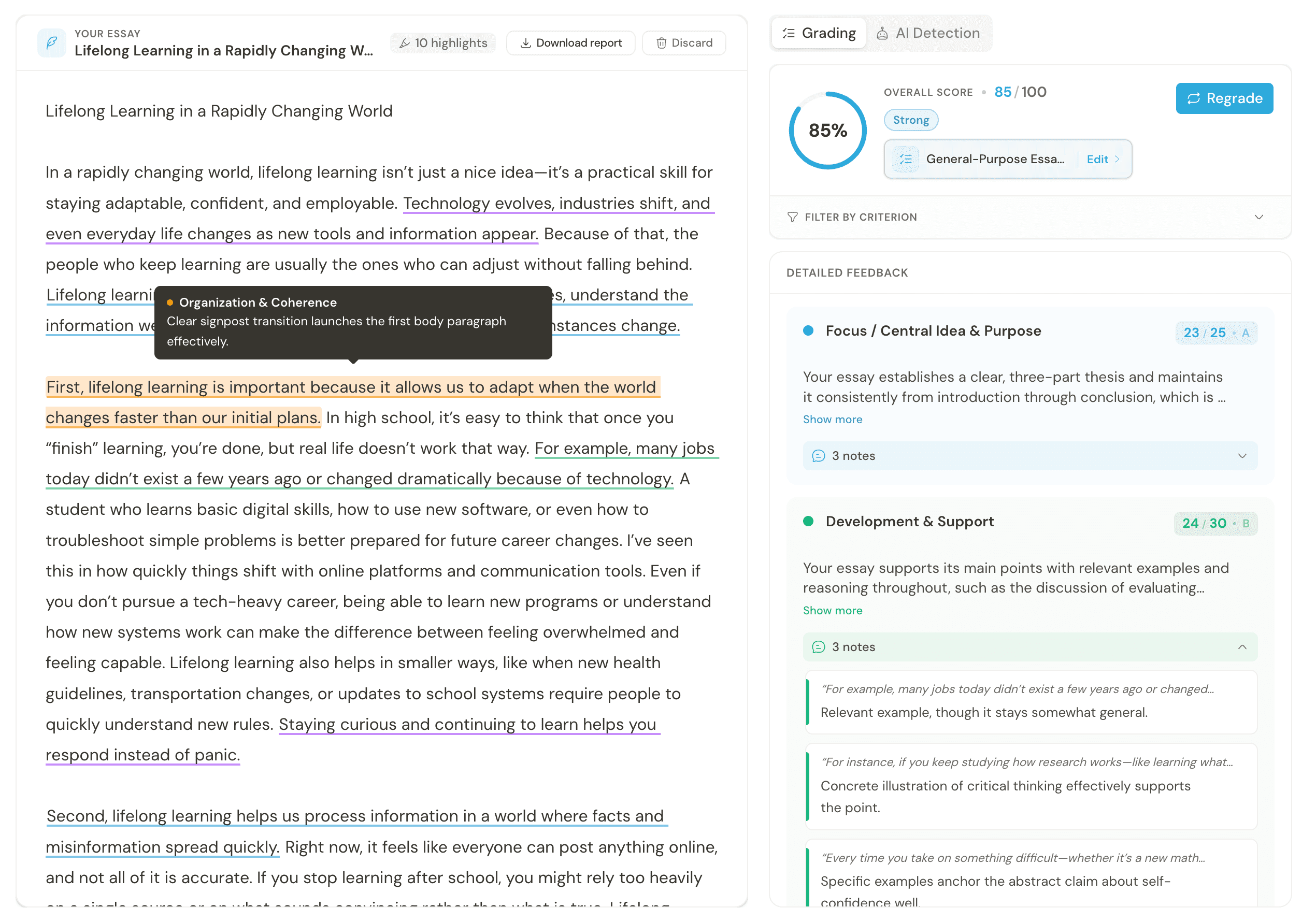
Best for: Teachers who want an AI essay grader with rubric-based scoring and editable feedback.
Compare all plans and what's included on the Clasa AI pricing page.
Clasa is the strongest option for teachers who want grading aligned with their own standards. The combination of rubric-based grading, editable feedback, and built-in AI detection makes it particularly useful for educators who need consistency without giving up control of the final evaluation.
Try Clasa free, upload an essay and your rubric, and get a scored, criterion-by-criterion breakdown in under a minute.
EssayGrader is one of the most established tools built specifically for AI grading essays in educational settings. It focuses on helping teachers process large numbers of submissions quickly while maintaining consistent scoring and feedback.
The platform includes rubric support, AI-powered grading, and classroom integrations, making it a practical choice for teachers handling large classes.
Best for: Teachers grading dozens of essays throughout the term.
EssayGrader is a strong choice for teachers who prioritize speed and efficiency. If your biggest challenge is working through large stacks of essays, it offers a practical solution. Teachers who want deeper control over rubric criteria and final feedback may prefer a more rubric-driven platform.
CoGrader is a strong option for teachers who already use Google Classroom and want grading to fit naturally into their existing workflow. It combines rubric-based assessment, AI-generated feedback, and classroom integrations designed to reduce administrative work.
Its biggest strength is convenience. Teachers can stay inside familiar systems rather than moving between multiple tools.
Best for: Teachers who rely heavily on Google Classroom and digital assignment workflows.
CoGrader is one of the best options for teachers whose workflow already revolves around Google Classroom. The integrations are useful and time-saving. For teachers specifically searching for an AI essay grader with rubric support, editable comments, and built-in AI detection in one place, other tools may offer a more complete grading workflow.
MagicSchool is best for teachers who want more than just essay grading. While it includes tools that help with writing feedback and assessment, its main strength is offering a wide range of AI tools for lesson planning, communication, differentiation, and classroom support.
For schools already using AI across multiple teaching tasks, MagicSchool can serve as a central hub rather than a dedicated grading solution.
Best for: Teachers looking for a broader AI toolkit beyond essay grading.
MagicSchool is a strong choice for educators who want one platform for multiple classroom tasks. If essay grading is only part of your workflow, it offers excellent value. If grading and feedback are your primary concerns, dedicated essay-grading tools may provide more depth.
Brisk Teaching is designed for teachers who spend most of their time reviewing student work inside Google Docs. Its browser-based workflow allows educators to generate feedback, comments, and instructional suggestions without constantly switching between platforms.
Rather than functioning as a dedicated AI essay grader, Brisk focuses on making existing teaching workflows more efficient. Teachers can review student work, provide feedback, and support revision directly where writing already happens.
Best for: Teachers who review and comment on student writing primarily in Google Docs.
Brisk Teaching works best for educators who already spend most of their grading time inside Google Docs. It improves efficiency without requiring major workflow changes. Teachers seeking detailed rubric scoring, criterion-level reports, and integrated AI detection may find dedicated grading platforms a better fit.
PaperRater has been available for years and remains one of the most accessible free essay-checking tools on the market. It focuses on grammar, spelling, readability, writing quality, and automated scoring rather than rubric-based classroom grading.
While it lacks many of the features found in newer AI essay graders for teachers, it can still be useful for quick reviews and basic writing feedback.
Best for: Students and teachers looking for a simple free essay checker.
PaperRater remains a useful free tool for basic essay checking. However, teachers looking for criterion-based grading, AI essay feedback, AI detection, or rubric-aligned assessment will likely outgrow it quickly.
The best AI essay grader depends on your grading process, workload, and classroom needs.
If you grade against a custom rubric, prioritize tools that allow rubric uploads and criterion-level scoring. Platforms such as Clasa and CoGrader are designed around rubric-based assessment rather than generic scoring systems.
If AI-written submissions are your biggest concern, look for platforms that combine grading and AI detection in a single workflow. This reduces the need to switch between multiple tools and provides additional context when reviewing student work.
If your school already relies heavily on Google Classroom, choosing a platform with strong integrations can save significant administrative time. CoGrader and Brisk Teaching are particularly useful for educators working within Google's ecosystem.
If you need support beyond essay grading, MagicSchool offers a broader collection of AI-powered teaching tools for lesson planning, communication, differentiation, and classroom support.
If budget is the main consideration, starting with a free AI essay grader for teachers can be a practical approach. Most platforms offer free plans that allow educators to evaluate the workflow before upgrading.
Finally, consider how much control you want over feedback. The strongest grading tools help teachers save time while still allowing them to review, edit, and approve comments before students receive them.
The right choice is usually the one that fits your workflow, not necessarily the one with the longest feature list.
A good AI essay grader should do more than assign a score. It should help teachers provide faster, more consistent, and more actionable feedback while reducing the time spent on repetitive grading tasks.
Rubric alignment is one of the most important factors. When grading follows teacher-defined criteria, students receive feedback that matches classroom expectations rather than generic standards. This improves consistency across assignments and helps students understand exactly how their work is being evaluated.
Feedback quality matters just as much as scoring accuracy. Effective AI essay feedback should explain what students did well, where they lost points, and what they can improve. The best tools provide criterion-level feedback instead of simple overall comments.
Teachers should also consider AI detection, privacy practices, ease of use, bulk grading capabilities, and whether the platform allows human oversight. AI can help with grading, but educators should remain responsible for final decisions.
The strongest tools combine efficiency with teacher control rather than replacing professional judgment.
AI essay graders can be accurate when used as a first-pass grading assistant, but they should not replace teacher judgment entirely.
Modern tools are capable of analyzing writing patterns, applying rubric criteria, identifying strengths and weaknesses, and generating detailed feedback in seconds. This can significantly reduce grading time, particularly for teachers handling large numbers of essays.
However, writing is complex. Creativity, nuance, context, and assignment-specific expectations still require human review. AI may occasionally miss context that an experienced teacher would immediately recognize.
For that reason, the most effective approach is to use AI grading as a support system rather than a replacement for educator expertise. The teacher reviews the feedback, adjusts comments if needed, and makes the final decision before returning work to students.
Yes. Several platforms offer free plans, including Clasa, EssayGrader, CoGrader, MagicSchool, and PaperRater. Free plans typically include usage limits, but they provide enough access for teachers to evaluate whether the platform fits their workflow.
For teachers who rely on custom grading criteria, Clasa and CoGrader are among the strongest options because they support rubric-based assessment. This allows grading to follow teacher-defined standards rather than a fixed scoring model.
AI can provide accurate first-pass evaluations when paired with clear grading criteria and well-defined rubrics. Teachers should still review results to ensure fairness, accuracy, and proper interpretation of context.
Many schools and institutions allow AI grading tools as instructional support systems. Policies vary by district, school, university, and country, so educators should review local guidelines before implementation.
Privacy practices differ between providers. Teachers should review each platform's privacy policy and data-handling procedures before uploading student work, especially when working with sensitive educational information.
The answer depends on your goals. For rubric-based college essay evaluation, Clasa and EssayGrader offer stronger grading features. For basic grammar and writing checks, PaperRater remains a useful free option.
Some can. Clasa, EssayGrader, and selected CoGrader plans include AI detection capabilities. Results should be treated as indicators rather than definitive proof and should always be reviewed alongside the student's work.
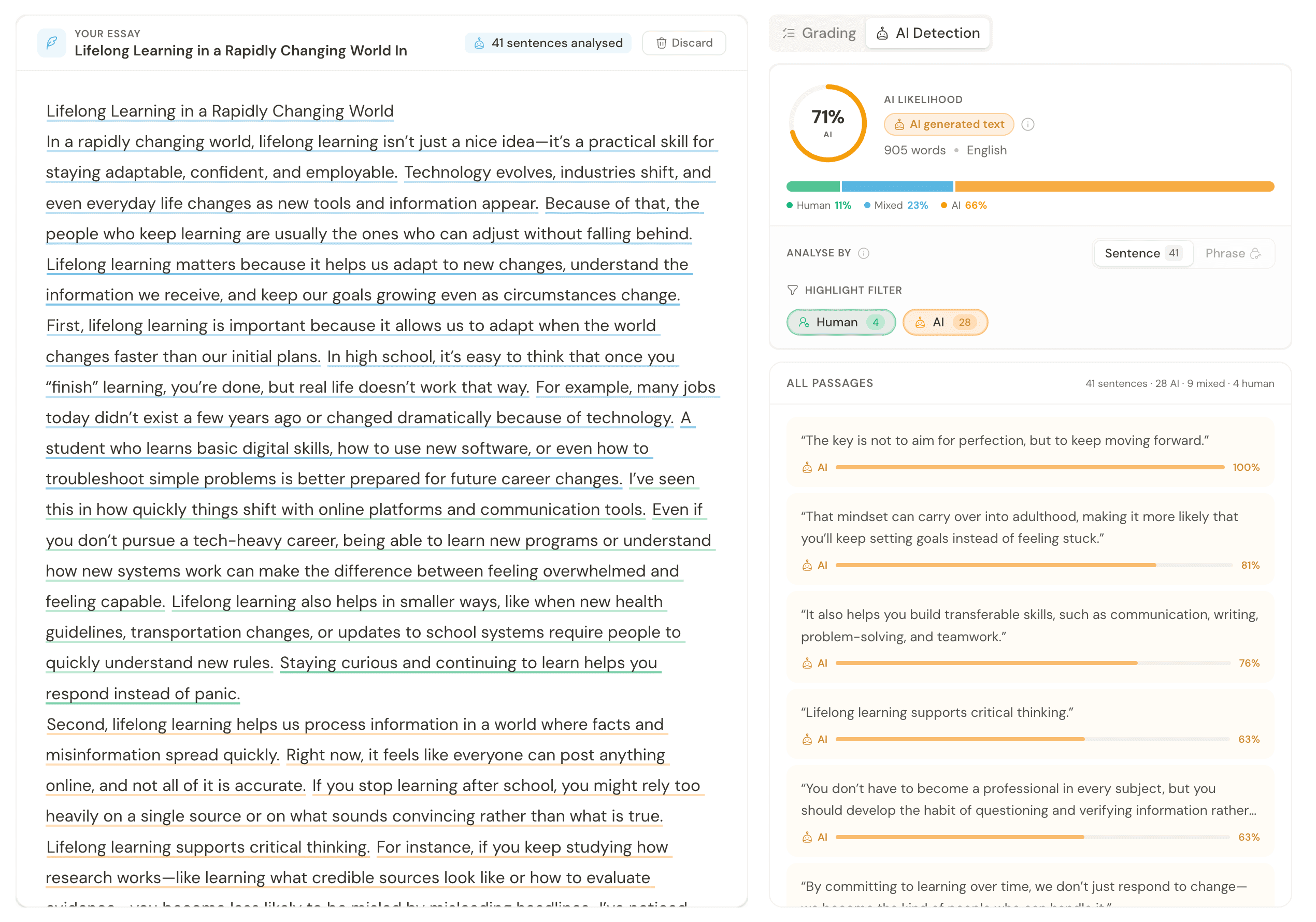
The best AI for grading essays is the one that matches your grading process. Teachers who use detailed rubrics typically benefit most from tools that support custom criteria, editable feedback, transparent scoring, and AI detection.
For most educators, Clasa is the best AI essay grader for teachers in 2026 because it combines rubric-based grading, editable feedback, and AI detection in a single workflow. Teachers already working inside Google Classroom may prefer CoGrader, while MagicSchool is worth considering for educators looking for a broader AI teaching assistant platform.
No matter which tool you choose, the goal should be the same: spend less time on repetitive grading tasks and more time helping students improve their writing.
Try Clasa free, upload an essay and your rubric, receive a scored criterion-by-criterion breakdown, review the feedback, and export a report in minutes. Start grading free at Clasa.ai.